New Jersey homeowners who need a new water well, a pump system replacement, or emergency well service have one non-negotiable requirement to meet before any work begins — the contractor must hold a valid New Jersey Department of Environmental Protection license. NJ water well drilling is regulated under N.J.A.C. 7:9D, and unlike several other states, New Jersey offers no homeowner exemption. Only a licensed well drilling contractor can legally drill, install, or abandon a water well on your property. This guide covers everything you need — NJ well drilling costs by county, permit requirements, water quality rules, and how to find qualified well drilling companies near you across all regions of New Jersey.
NJ Well Drilling Regulations — What Every Homeowner Must Know
New Jersey takes groundwater protection seriously, and the regulations around well drilling reflect that. The state construction standards under N.J.A.C. 7:9D govern everything from how a well must be drilled and cased to how the finished well record gets submitted to the NJDEP Bureau of Water Allocation. Every well driller working in New Jersey must be licensed by the state, and every job must be permitted before drilling begins.
The New Jersey Groundwater Association (NJGWA) and the National Ground Water Association (NGWA) both maintain directories of certified contractors working across the state. Hiring a member of either association gives you additional assurance that the contractor stays current on industry standards, environmental requirements, and best practices for protecting natural resources and groundwater quality.
NJDEP License — Master Well Driller vs Journeyman Well Driller
New Jersey issues two levels of well drilling license, and the distinction matters when you are hiring a contractor.
A Master Well Driller holds the highest level of certification available in New Jersey. Only a Master Well Driller can pull a well permit, take legal responsibility for a project, and supervise all drilling activity on a job site. When you receive a quote from a well drilling company, confirm that a licensed Master Well Driller will oversee your project from start to finish.
A Journeyman Well Driller is licensed to perform drilling work under the direct supervision of a Master. Journeymen are qualified and experienced professionals, but they cannot independently manage a project or submit permit applications. Many of the best family owned well drilling businesses in New Jersey operate with a combination of Master Drillers and Journeymen on their crews.
If you want to verify a contractor’s license status before signing anything, the NJDEP maintains a searchable list of licensed well drillers. Cross checking the license number a contractor provides takes less than five minutes and protects you from hiring someone operating outside their certification level.
Well Drilling Permits in New Jersey
Every new water well in New Jersey requires an NJDEP permit before any drilling begins. The permit application is submitted jointly by the property owner and the licensed well drilling contractor through the NJDEP’s online e-permit portal.
Key permit details every homeowner should know:
- Standard permit fee: $130
- High capacity well permit (70 gallons per minute or more): $250
- Typical approval time: 1 to 2 weeks
- After drilling is complete, the contractor must submit a Well Record (as-built log) to the NJDEP within 90 days
Most established NJ well drilling contractors handle the permit submission as part of their standard service. Always confirm this is included before work begins so there are no surprises with timing or compliance.
Cost to Drill a Well in NJ — 2026 Complete Guide
The cost to drill a well in NJ varies based on where your property is located, how deep the well needs to go, and what type of pump and tank system you install. Across the state, a complete residential water well system typically runs between $5,000 and $20,000. The statewide average sits around $8,460 for a standard 180-foot well, with drilling rates generally falling between $30 and $68 per foot.
Here is a full breakdown of what New Jersey homeowners typically pay:
| Cost Item | Typical Range |
|---|---|
| Well drilling and casing | $3,000 to $9,000 |
| Drilling rate per foot | $30 to $68 |
| Pump installation | $1,000 to $2,500 |
| Pressure tank and installation | $300 to $500 |
| Electrical controls and wiring | $200 to $500 |
| Water testing panel | $100 to $250 |
| NJDEP permit fee | $130 standard / $250 high capacity |
| Local county health department fees | $0 to $200 |
| Total complete well system | $5,000 to $20,000+ |
Use our free Well Drilling Cost Calculator to get a more detailed estimate based on your location, depth, and system requirements.
NJ Well Drilling Cost by County — 2026
Where you live in New Jersey has a major impact on what you will pay for water well drilling. The state divides roughly into two geological zones at what geologists call the fall line, and cost differences between the two regions are significant.
| County | Region | Avg Well Depth | Approx Total Cost |
|---|---|---|---|
| Sussex County | North NJ Highlands | 300 to 500 ft | $9,000 to $22,000 |
| Morris County | North NJ Highlands | 250 to 450 ft | $8,500 to $20,000 |
| Hunterdon County | North NJ Highlands | 220 to 400 ft | $7,500 to $18,000 |
| Warren County | North NJ Highlands | 200 to 380 ft | $7,000 to $17,500 |
| Monmouth County | Transition Zone | 150 to 300 ft | $6,000 to $15,000 |
| Ocean County | South NJ Coastal Plain | 80 to 200 ft | $5,000 to $12,000 |
| Burlington County | South NJ Coastal Plain | 60 to 180 ft | $4,500 to $11,000 |
| Atlantic County | South NJ Coastal Plain | 60 to 160 ft | $4,500 to $10,500 |
| Cape May County | South NJ Coastal Plain | 50 to 140 ft | $4,000 to $10,000 |
| Camden County | South NJ Coastal Plain | 70 to 170 ft | $4,500 to $11,000 |
These are estimates based on typical conditions. Your actual cost depends on the specific rock and soil formations encountered during drilling, the pump and tank system you choose, and current contractor rates in your area. Getting quotes from two or three licensed NJ well drilling companies before committing is always worth the time.
North NJ vs South NJ — Why Drilling Costs Differ So Much
This is one of the most important things to understand before budgeting for a new water well in New Jersey, and most homeowners are surprised by how much location matters.
Northern New Jersey sits on the Highlands and Piedmont regions, which are made up of igneous and metamorphic bedrock including granite, gneiss, and basalt. Drilling through this hard rock takes significantly more time and equipment wear than softer formations. Wells in this region reach water through fractures in the bedrock rather than through porous aquifer layers, and reaching a productive fracture zone often means drilling 300 feet or deeper. Morris County, Sussex County, and Hunterdon County homeowners consistently see the highest well drilling costs in the state for this reason.
Southern New Jersey sits on the Coastal Plain, an entirely different geological environment. The formations here consist of unconsolidated sand, gravel, and clay deposited over millions of years. Drilling through these softer materials is faster, easier, and less expensive per foot. Water is typically found at much shallower depths, often between 60 and 200 feet. Ocean County, Burlington County, Atlantic County, and Cape May County all fall in this zone. The trade-off is that shallow coastal plain wells require careful casing and sealing to prevent surface water intrusion, particularly in areas closer to tidal influences.
Factors That Affect NJ Well Drilling Cost
Several variables determine the final cost of your water well system in New Jersey:
- Depth required — the single biggest cost driver; every additional foot adds drilling, casing, and pump costs
- Geology — hard bedrock in North NJ costs significantly more per foot than Coastal Plain formations in South NJ
- Casing type — steel casing is required for bedrock wells; PVC casing is used in unconsolidated Coastal Plain formations
- Pump horsepower — deeper wells need more powerful submersible pumps, which cost more upfront and slightly more to run
- Pump and tank system size — households with higher water demand need larger systems
- Water treatment equipment — arsenic filtration, iron removal, or water conditioning systems add cost if your water quality requires treatment
- Emergency vs scheduled service — emergency well service and pump repairs outside regular business hours carry premium rates
- Access and site conditions — steep terrain, limited truck access, or protected environmental areas can add mobilization costs
NJ Water Well Drilling Process — Step by Step
Understanding the process before your contractor arrives helps you ask better questions and avoid surprises. Here is how residential water well drilling works in New Jersey from first call to running water.
Step 1 — Initial Consultation and Site Assessment Your NJ well drilling contractor visits the property to assess the geology, review local groundwater depth records, check setback requirements from septic systems and property boundaries, and identify any environmental or regulatory restrictions that apply to your lot. This visit gives the contractor what they need to provide an accurate quote.
Step 2 — NJDEP Permit Application The property owner and the licensed well drilling contractor jointly submit an e-permit application through the NJDEP online portal. Standard permit approval takes one to two weeks. No drilling can legally begin before permit approval is in hand.
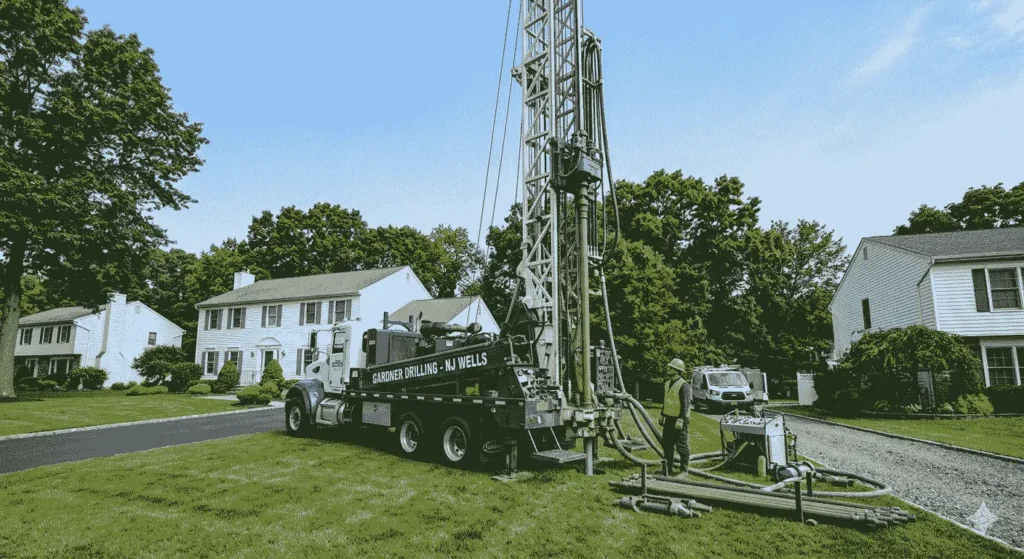
Step 3 — Drilling Begins The drill rig arrives on site and drilling begins. In North NJ bedrock areas, rotary or air rotary methods are used to bore through hard granite and gneiss formations. In South NJ Coastal Plain areas, mud rotary or cable tool methods work through unconsolidated sand and gravel layers. Drilling continues until the contractor reaches a reliable water bearing zone at adequate yield for your household.
Step 4 — Well Casing and Grouting Steel or PVC casing is installed inside the borehole to protect the well from surface contamination and structural collapse. Grout is pumped into the annular space around the casing to seal the well from surface water intrusion. New Jersey regulations under N.J.A.C. 7:9D specify minimum casing depth and grouting standards that every licensed contractor must meet.
Step 5 — Pump and Tank Installation A submersible pump is lowered into the completed well and connected to your pressure tank and home plumbing system. The pump is sized based on well depth, expected yield, and household water demand. A properly sized pump and tank system delivers consistent water pressure throughout the home and reduces unnecessary pump cycling, which extends the life of both components significantly.
Step 6 — Shock Chlorination and Disinfection Before water testing begins, the new well is shock chlorinated to disinfect the borehole, casing, and pump system. This step is required in New Jersey before any water sample is collected for laboratory analysis. The well is then flushed thoroughly to clear the chlorine before sampling.
Step 7 — Water Testing A water sample is collected and sent to a certified laboratory for analysis. New Jersey requires testing for total coliform bacteria, E. coli, and nitrates at minimum before a new well is put into service. A comprehensive pre-use panel also includes arsenic, lead, pH, iron, and hardness. In certain New Jersey counties, PFAS testing is also recommended given known regional contamination in groundwater.
Step 8 — Well Record Submission Within 90 days of completing the well, the licensed contractor submits a detailed Well Record to the NJDEP documenting the depth, geology encountered, casing specifications, pump details, and water quality results. This record becomes part of the permanent state groundwater database and stays with the property.
NJ Well Drilling Services — Residential and Commercial
Well drilling companies across New Jersey offer a comprehensive range of water system services. Whether you are a first-time homeowner installing a new residential water well or a commercial property owner upgrading an aging system, here is what qualified NJ well drilling contractors provide:
Residential Water Well Drilling — New well construction for single family homes, multi family properties, and rural residential lots throughout New Jersey.
Commercial Well Drilling — Higher yield wells for businesses, industrial facilities, agricultural operations, and irrigation systems requiring larger water storage and delivery capacity.
Pump and Tank Services — Submersible pump installation, pump repair, pump replacement, pressure tank installation, and full pump and tank system upgrades. Emergency pump service is available from most established NJ contractors when a household loses water without warning.
Geothermal Well Drilling — Closed loop and open loop geothermal systems for residential and commercial heating and cooling. Geothermal installation is particularly active in Morris, Hunterdon, and Somerset counties where the bedrock geology supports efficient geothermal loop systems. Several NJ well drilling companies hold memberships with geothermal industry associations and maintain specialized equipment for this work.
Water Treatment and Conditioning — Whole house water filtration, arsenic removal systems, iron filtration, water softeners, and water conditioning units. Water treatment is a natural extension of well drilling services because water quality issues like arsenic, iron, and hardness are often identified during the required pre-use testing panel.
Hydrofrac and Well Rehabilitation — Hydrofracking increases water yield in low producing bedrock wells by pumping water at high pressure into the well to fracture the surrounding rock and open new water bearing zones. This service is particularly common in North NJ highland bedrock areas where some wells produce less water than the household requires.
Irrigation Well Drilling — Dedicated irrigation wells for residential lawns, agricultural properties, and commercial landscaping operations. A separate irrigation well keeps your drinking water system independent of your outdoor water demand.
Emergency Well Service and Repairs — Loss of water pressure, complete loss of water, pump motor failure, and pressure tank waterlogging all require fast response. Most established NJ well service contractors offer emergency availability outside regular business hours.
Well Abandonment — Properly decommissioning an old or unused well according to NJDEP regulations. Well abandonment requires a licensed contractor and a permit, just like new well construction.
Water Testing Requirements for NJ Wells
New Jersey has some of the most comprehensive private well water testing requirements of any state in the northeast, and every well owner should understand what is required and what is recommended.
Before First Use Before a newly drilled well can be used for drinking water, New Jersey requires testing for total coliform bacteria, E. coli, nitrates, and pH at minimum. A comprehensive pre-use panel covering arsenic, lead, iron, hardness, and manganese costs between $100 and $250 at most certified labs and is strongly recommended given the known groundwater quality issues in various parts of the state.
The NJ Private Well Testing Act One regulation that sets New Jersey apart from most other states is the Private Well Testing Act. This law requires mandatory water quality testing whenever a property with a private well is sold or transferred. The results must be provided to the buyer before closing. Tests required under this act include total coliform, fecal coliform, nitrates, pH, iron, manganese, and several volatile organic compounds. This testing requirement applies statewide and applies regardless of how recently the well was drilled.
Arsenic in NJ Well Water Arsenic occurs naturally in the bedrock formations across northern New Jersey and is one of the most common water quality concerns for well owners in Morris, Sussex, Warren, and Hunterdon counties. If your property sits in a North NJ highland area, arsenic testing is not optional — it is essential before using your well water for drinking or cooking. Arsenic contamination in well water has no taste or odor, making laboratory testing the only reliable detection method. Treatment options including point-of-entry reverse osmosis systems and arsenic-specific filtration units are available and effective.
Annual Testing Recommendations Even after your well passes its initial pre-use testing panel, the NJDEP recommends annual testing for total coliform bacteria and nitrates as a minimum. Well water quality can change over time due to surface activity, septic system proximity, or changes in regional groundwater conditions. Annual testing is particularly important for households with infants, elderly residents, or immunocompromised individuals who are more vulnerable to waterborne contaminants.
Areas We Serve in New Jersey
Our network covers licensed well drilling contractors serving residential and commercial properties across all 21 New Jersey counties. Whether you are in the Highlands of North Jersey or along the Coastal Plain in South Jersey, we connect property owners with experienced local drillers who know the geology, groundwater depths, and permit requirements in their specific area.
Well Drilling in Mullica, NJ
Mullica Township sits in Burlington County in the heart of the New Jersey Pinelands, one of the most ecologically significant groundwater recharge areas on the East Coast. The Coastal Plain geology here means wells typically reach water at relatively shallow depths between 60 and 150 feet, moving through layers of sand and gravel rather than hard bedrock. Water quality in the Mullica area is generally good, though the naturally acidic character of Pinelands groundwater means pH testing is particularly important for new wells in this region.
Well drilling contractors serving Mullica Township and surrounding Burlington County communities including Hammonton, Egg Harbor, and Sweetwater operate in an area where the Kirkwood-Cohansey aquifer provides one of the largest untapped freshwater reserves in the northeastern United States. Local contractors who have worked extensively in the Pinelands understand the specific environmental sensitivity of drilling in this region and the additional care required to protect the surrounding natural resources.
Homeowners in Mullica and the surrounding Pinelands area looking for well service, pump installation, or new residential water well drilling will find that the combination of shallow depths and good aquifer conditions generally makes this one of the more affordable regions in New Jersey for new well construction.
Well Drilling in Monmouth County, NJ
Monmouth County sits at the geological transition zone between the Piedmont in the northwest corner of the county and the Coastal Plain that covers most of its area. This means well drilling costs and depths vary considerably depending on exactly where your property sits. Communities in western Monmouth County such as Marlboro, Manalapan, and Millstone may encounter harder rock formations requiring deeper drilling, while coastal and central Monmouth towns including Freehold, Howell, and Brick Township typically fall in the Coastal Plain zone with shallower, more predictable water tables.
Monmouth County has a large population of private well owners and an active well drilling and service industry to match. Emergency well service and pump repair availability is strong across the county given the density of residential well systems in operation.
Well Drilling in Morris County, NJ
Morris County represents the heart of North Jersey well drilling territory. The Highlands bedrock here — granite, gneiss, and schist formations — requires the most powerful drill rigs and the longest drilling times of anywhere in the state. Wells in Morris County routinely reach 300 to 450 feet before encountering productive fracture zones in the bedrock, and total project costs at the higher end of the New Jersey range are common.
Towns including Parsippany, Morristown, Roxbury, Randolph, and Chester have significant populations on private wells. The family owned well drilling businesses that have operated in Morris County for generations have drilled enough local wells to know which areas tend to produce water at shallower depths and which require extended drilling before finding adequate yield.
Well Drilling in Atlantic and Cape May Counties, NJ
South Jersey well drilling in Atlantic and Cape May counties sits at the affordable end of the New Jersey cost spectrum. The unconsolidated Coastal Plain formations in these counties allow for relatively fast drilling at shallower depths, typically between 50 and 160 feet. Atlantic City surroundings, communities along the Cape May peninsula, and inland Atlantic County towns all benefit from the naturally productive Coastal Plain aquifer system.
Water quality considerations in coastal South Jersey include saltwater intrusion risk in properties very close to tidal areas, and the naturally elevated iron levels common in many Coastal Plain aquifers. Iron filtration and water conditioning systems are frequently installed alongside new wells in this region.
Well Drilling in Ocean County, NJ
Ocean County is one of the most active well drilling markets in South Jersey. Toms River, Brick, Lacey Township, and Stafford Township all have large numbers of residential well systems. The Coastal Plain geology produces consistent water at reasonable depths, and well drilling and pump service companies in Ocean County maintain high availability for both new installations and emergency repairs given the volume of active well systems in the area.
How to Find and Hire a Licensed NJ Well Drilling Contractor
Hiring the right contractor is the most important decision you make in the entire well drilling process. Here is what to check before signing any agreement:
Verify the NJDEP License — Ask for the contractor’s NJDEP license number and confirm whether they hold a Master Well Driller designation. Only a Master Driller can pull permits and legally supervise your project. The NJDEP maintains a searchable license database you can check in minutes.
Confirm a Master Driller Will Be On Site — Some companies send Journeymen to job sites without adequate Master supervision. Confirm in writing that a licensed Master Well Driller will be present and responsible for your installation from start to finish.
Get Two or Three Written Quotes — Costs vary significantly between NJ well drilling companies even within the same county. A written quote should cover drilling cost per foot, estimated depth range, casing type, pump specifications, pressure tank, water testing, and permit fees. Never accept a verbal quote only.
Ask About Their Experience in Your Area — A contractor who has drilled dozens of wells in your specific town or county knows the local water table depths, common rock formations, and any known water quality issues in your area. This local experience translates directly into more accurate depth estimates and fewer surprises during the job.
Check for Insurance Coverage — A legitimate NJ well drilling company carries general liability insurance and workers compensation. Ask for insurance certificates before any equipment arrives on your property.
Confirm Water Testing is Part of the Service — Some contractors include basic water testing in their quote. Others bill it separately. Confirm what tests are performed, whether they use a MassDEP or NJDEP certified laboratory, and who receives the results.
Check Reviews and Ask for References — Google reviews give a useful picture of how a company handles problems, not just routine jobs. Ask specifically for references from jobs completed in your area within the past year.
Frequently Asked Questions — Well Drilling in New Jersey
How much does it cost to drill a well in NJ?
A complete residential water well system in New Jersey typically costs between $5,000 and $20,000. The statewide average for a 180-foot well runs around $8,460, with drilling rates between $30 and $68 per foot. North Jersey properties in bedrock areas generally cost more than South Jersey Coastal Plain properties due to deeper required depths and harder rock formations.
Do I need a permit to drill a well in New Jersey?
Yes. New Jersey requires an NJDEP permit for every new water well before drilling begins. The application is submitted jointly by the property owner and the licensed well drilling contractor through the NJDEP e-permit portal. Standard permit fee is $130, or $250 for high capacity wells producing 70 gallons per minute or more. Approval typically takes one to two weeks.
Can a homeowner drill their own well in New Jersey?
No. New Jersey offers no homeowner exemption for well drilling. Only a contractor holding a valid NJDEP well driller license can legally drill, install, or abandon a water well in the state. Attempting to drill without a licensed contractor and proper permit exposes the property owner to significant legal and environmental liability.
How deep are wells in New Jersey?
Well depth in New Jersey varies considerably by region. North Jersey bedrock wells in Morris, Sussex, and Hunterdon counties typically reach 250 to 500 feet. South Jersey Coastal Plain wells in Burlington, Atlantic, Ocean, and Cape May counties usually find reliable water between 50 and 200 feet. The statewide average is approximately 180 feet.
How long does the well drilling process take in New Jersey?
From your first call to having certified potable water, expect the process to take three to six weeks in most cases. The drilling itself typically takes one to three days on site. Permitting and water testing are generally the longest steps in the timeline.
Is arsenic a concern in NJ well water?
Yes, particularly in northern New Jersey. Arsenic occurs naturally in the Highlands bedrock formations across Morris, Sussex, Warren, and Hunterdon counties and has no taste, color, or odor in water. Testing for arsenic is a standard part of any responsible pre-use water testing panel for new NJ wells. Effective treatment options including reverse osmosis and arsenic-specific filtration are widely available and installed by most well drilling and water treatment contractors in the region.
What is the NJ Private Well Testing Act?
The New Jersey Private Well Testing Act requires mandatory water quality testing whenever a property served by a private well is sold or transferred. Sellers must provide buyers with certified laboratory test results covering bacteria, nitrates, pH, iron, manganese, and several organic compounds before the transaction closes. This requirement applies statewide to all residential properties with private wells regardless of the well’s age or previous test history.
What is the difference between a Master Well Driller and a Journeyman Well Driller in NJ?
A Master Well Driller holds the highest NJDEP certification and is the only license level permitted to pull permits, take legal responsibility for a project, and independently supervise all drilling work. A Journeyman Well Driller is qualified to perform drilling under the direct supervision of a Master. When hiring a well drilling contractor in New Jersey, always confirm that a licensed Master Well Driller will oversee and be present for your installation.
Does well drilling in NJ affect my property value?
A properly drilled, permitted, and documented water well generally has a neutral to positive effect on property value in areas where municipal water is not available. In rural New Jersey communities where private wells are the standard water source, a newer well system with recent clean water tests is a straightforward selling point. The NJ Private Well Testing Act ensures that well water quality is a documented and disclosed part of any property sale transaction.