Planning a new well on your property? Before you call a single contractor, use this free well drilling cost calculator to get a realistic estimate for your project. Enter your well depth, soil type, state, and additional services — and get an instant detailed cost breakdown. No signup, no email, no obligation. Just an accurate starting point to help you budget with confidence.
All figures are based on current average pricing from well drilling contractors across the United States, with detailed data for Rhode Island and the Northeast region.
💧 Well Drilling Cost Calculator
Enter your project details below to get an instant cost estimate. Free to use — no signup required.
Ready to get real quotes? Connect with licensed well drillers in your area.
Get Free Quotes →Estimates are based on average contractor pricing across the US with regional adjustments. Actual costs vary based on site conditions, contractor pricing, and local regulations. Always get 2–3 quotes from licensed well drilling companies before starting your project.
How to Use This Well Drilling Cost Calculator
Getting an estimate takes less than a minute. Here is exactly what to enter:
Step 1 — Enter Your Well Depth Enter your estimated or required well depth in feet. If you are not sure, check with your local Department of Environmental Management for groundwater depth data in your county, or use 200 feet as a reliable starting point for most Rhode Island residential properties. Deeper wells cost more per foot due to increased drilling time and equipment wear.
Step 2 — Select Your Soil or Rock Type Soil and geology have a major impact on your overall cost. Soft soil and sandy ground drills faster and cheaper than hard granite bedrock. Rhode Island has a significant amount of glacial till and granite underground, especially in inland areas — so expect costs on the higher end if your property sits in Providence or Kent County.
Step 3 — Choose Your State Well drilling costs vary by region due to differences in labor costs, geology, and state permit requirements. Select your state from the dropdown to get cost estimates adjusted for your area. This calculator covers all US states with detailed data for Rhode Island, Massachusetts, Connecticut, New Jersey, and New York.
Step 4 — Select Additional Services Drilling the well is just one part of the total installation. Check any additional services you need — pump installation, pressure tank, electrical wiring, water testing, and permit fees. Each item adds to your total but is essential for a fully operational well system.
Step 5 — Review Your Cost Estimate The calculator will generate an estimated cost range based on your inputs. Use this figure as a budget guide when requesting quotes from local well drilling companies. Always compare at least two to three quotes from reputable, licensed contractors in your area before making a final decision.
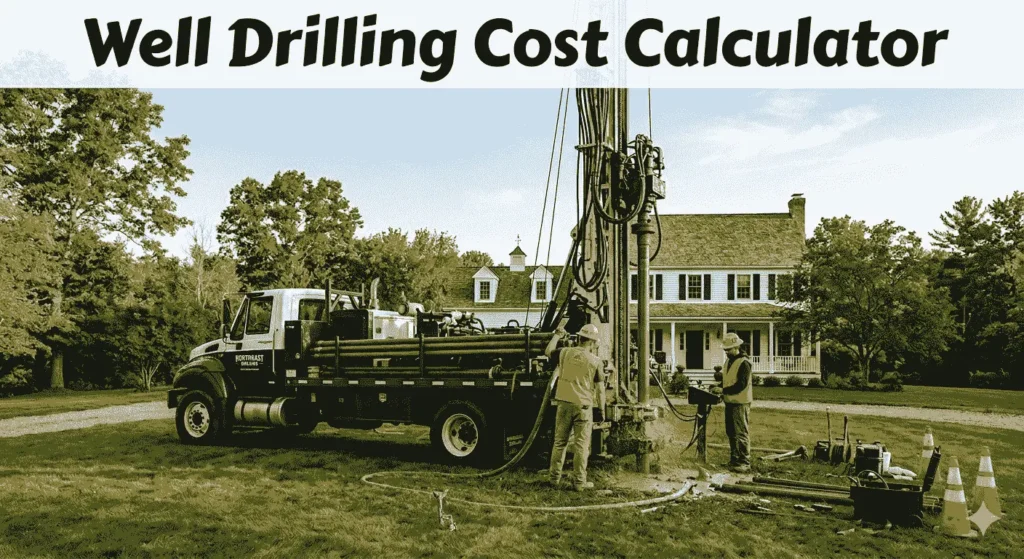
Average Cost of Drilling a Water Well in 2026
The national average cost to drill a residential water well ranges from $25 to $65 per foot, with a complete well system — including pump, pressure tank, electrical, and water testing — typically costing between $5,000 and $18,000 for most homeowners.
Costs vary significantly depending on your location, the depth required to reach a reliable groundwater supply, and the geology of your site. Rocky terrain and hard granite bedrock increase both drilling time and equipment costs, pushing your per foot quote to the higher end of the range.
| Well Depth | Drilling Only | Complete System |
|---|---|---|
| 100 feet | $2,500 – $6,500 | $4,500 – $10,000 |
| 200 feet | $5,000 – $13,000 | $7,500 – $16,500 |
| 300 feet | $7,500 – $19,500 | $10,500 – $24,000 |
| 400 feet | $10,000 – $26,000 | $13,500 – $32,000 |
These figures represent averages across the US. Rhode Island homeowners should budget toward the upper range due to the state’s granite-heavy geology and higher labor costs compared to national averages.
Well Drilling Cost Per Foot by Soil and Rock Type
Your well site geology is one of the biggest cost factors in any well drilling project. Drilling equipment works significantly harder through rocky and dense underground material, which increases both time on site and overall cost per foot.
| Soil or Rock Type | Cost Per Foot |
|---|---|
| Soft soil or sand | $15 – $25 |
| Clay or loam | $20 – $35 |
| Soft rock or shale | $30 – $50 |
| Hard granite bedrock | $45 – $65 |
Rhode Island sits on a mix of glacial deposits and granite bedrock. In coastal areas like Newport and Washington County, softer soils near the surface can reduce initial drilling costs. Inland areas in Providence and Kent County often hit granite at shallower depths, which increases your per foot drilling cost and the total depth needed to reach a sufficient groundwater supply.
If your property has never had a well before, ask local drilling companies what depths and soil conditions they typically encounter in your area. An experienced contractor with local expertise will give you a more accurate site-specific estimate than any online tool.
How Much Does It Cost to Drill a 100 Foot Well?
A 100 foot well is one of the shallower residential options. Drilling to this depth typically costs between $1,500 and $6,500 for drilling only, with a complete system ranging from $4,000 to $10,000 including pump installation, pressure tank, electrical wiring, and water testing.
In practice, 100 foot wells are less common in Rhode Island. Most properties in the state require a minimum depth of 150 to 200 feet to reach a reliable, year-round groundwater supply. Shallow wells in Rhode Island are also more vulnerable to seasonal fluctuation and surface contamination, which can affect long-term water quality.
That said, properties in low-lying coastal areas or near natural water sources may reach sufficient groundwater at shallower depths. Your drilling contractor will confirm this during the site assessment phase before drilling begins.
How Much Does It Cost to Drill a 200 Foot Well?
A 200 foot well is the most common residential depth in Rhode Island. Drilling to 200 feet typically costs between $5,000 and $13,000 for drilling only. A complete system — including a submersible pump, pressure tank, electrical connection, water testing, and permit fee — brings the total to $7,500 to $16,500 for most Rhode Island homeowners.
At 200 feet, most Rhode Island properties reach reliable, year-round groundwater. The depth is sufficient to access underground supplies below seasonal fluctuation levels, and water quality at this depth is generally better than shallower wells due to natural filtration through soil and rock layers.
Key cost factors at 200 feet:
- Soil vs bedrock encountered between 100 and 200 feet has a major impact on per foot drilling cost
- Pump horsepower requirements increase at greater depths — a 200 foot well typically needs a 1 HP to 1.5 HP submersible pump
- Casing material — steel vs PVC — affects both installation cost and long-term investment value
- Site access and terrain can add $500 to $2,000 to your total if the drill rig has limited access to your property
For most Rhode Island homeowners, budgeting $10,000 to $14,000 for a complete 200 foot well system gives a realistic range to work with when reviewing contractor quotes.
How Much Does It Cost to Drill a 400 Foot Well?
Drilling to 400 feet is a significant undertaking and represents the upper range of typical residential well drilling depth in Rhode Island. Drilling costs alone range from $10,000 to $26,000, with a complete system coming in at $13,500 to $32,000 depending on geology, pump requirements, and additional services.
A 400 foot well is typically needed when:
- Shallow groundwater is insufficient in volume or unreliable year-round
- Previous wells at shallower depths showed low GPM yield during pump testing
- Hard granite bedrock requires drilling well past the surface layer to reach a reliable water-bearing zone
- Water quality testing at shallower depths confirmed mineral contamination or high iron levels
At this depth, pump selection becomes critical. A 400 foot well requires a high-efficiency submersible pump with adequate horsepower to push water efficiently from underground to your pressure tank. An undersized pump at this depth will struggle to maintain consistent water supply and will wear out faster, reducing your long-term investment return on the well system.
Complete Well System Cost — Full Itemized Breakdown
Drilling is just one part of putting in a new water well. A complete installation includes multiple components, each with its own cost range. Here is a full breakdown of what goes into a new residential well system in Rhode Island:
| Component | Cost Range |
|---|---|
| Well drilling (per foot) | $25 – $65 |
| Well casing — steel or PVC | Usually included in drilling quote |
| Submersible pump | $800 – $2,000 |
| Pump installation labor | $300 – $600 |
| Pressure tank | $500 – $1,500 |
| Electrical wiring and hookup | $500 – $1,200 |
| Well cap and surface seal | $50 – $150 |
| Water quality testing | $100 – $400 |
| Rhode Island permit fee | $50 – $200 |
| Total complete system | $5,000 – $18,000 |
Well Casing Material — Most Rhode Island contractors use steel casing for deeper wells and PVC for shallower installations. Steel casing is more durable in rocky conditions and is better suited to Rhode Island’s granite geology. PVC is lighter and more efficient in softer soil but may not hold up as well over the long term in rocky underground conditions.
Pump Selection — A submersible pump is standard for drilled wells in Rhode Island. Your pump needs to be sized correctly for your well depth and household GPM demand. An undersized pump delivers low flow; an oversized pump wastes energy and increases wear. Your contractor should confirm pump sizing based on well depth and a pump test after installation.
Pressure Tank — The pressure tank stores pressurized water between pump cycles, reducing wear on the pump motor and maintaining consistent water pressure in your home. Budget $500 to $1,500 for a quality tank. A larger household or one with high water demand should invest in a larger tank for more efficient underground water delivery.
Well and Septic System Cost Combined
Many Rhode Island homeowners installing a new well are also putting in a septic system at the same time, especially on undeveloped properties. Budgeting for both together gives you a more accurate picture of total project cost.
- New well system: $5,000 – $18,000
- New septic system: $3,000 – $15,000
- Combined total: $8,000 – $33,000+
Rhode Island requires separate permits from the Department of Environmental Management for both well construction and septic installation. Both must meet state setback requirements — a minimum of 50 feet separation between a well and any septic component is required under Rhode Island regulations.
Always hire separate specialists for each system. Well drilling companies are licensed for water well construction; septic installation requires a licensed septic contractor. Some general contractors manage both and subcontract the well drilling, but confirm credentials and licensing before signing any agreement.
Well Drilling Cost by State — Northeast Focus
Well drilling costs vary across the US due to regional geology, labor rates, and state permit requirements. Here is how Rhode Island compares to neighboring states:
| State | Cost Per Foot | Average Complete System |
|---|---|---|
| Rhode Island | $25 – $65 | $5,000 – $18,000 |
| Massachusetts | $30 – $70 | $6,000 – $20,000 |
| Connecticut | $25 – $60 | $5,000 – $17,000 |
| New Jersey | $20 – $55 | $4,500 – $16,000 |
| New York | $25 – $60 | $5,000 – $17,000 |
| Pennsylvania | $20 – $50 | $4,000 – $15,000 |
| National Average | $20 – $60 | $3,750 – $15,000 |
Rhode Island sits in the mid-to-upper range for the Northeast due to its granite geology and relatively higher labor costs. If your property sits near the Massachusetts or Connecticut border, get quotes from licensed contractors in both states — pricing can vary even for properties close to state lines.
What Affects Well Drilling Cost the Most?
Understanding the key cost factors helps you ask better questions when reviewing contractor quotes and determine whether an estimate is realistic for your specific site.
Well Depth Depth is the single biggest cost driver in any well drilling project. Every additional foot drilled adds to your per foot quote, and deeper wells require more powerful pumps, longer casing runs, and more drilling time. In Rhode Island, the difference between a 150 foot well and a 300 foot well can mean a $5,000 to $10,000 difference in total cost.
Geology and Soil Conditions Rocky underground conditions — particularly hard granite bedrock common in Rhode Island — slow drilling progress and increase equipment wear. Contractors charge more per foot through granite than through soft soil or clay. Your contractor should review local Department of Environmental well records for your area to give you a more accurate depth and geology estimate before drilling begins.
Site Access and Terrain A drill rig needs clear access to your well site. Steep slopes, dense trees, soft ground, or narrow access points can all increase mobilization and setup costs. Difficult site access can add $500 to $2,000 or more to your total installation cost.
Pump Type and Horsepower The deeper your well, the more powerful the pump needed to efficiently bring water to the surface. A 1 HP submersible pump handles most wells up to 200 feet. Wells between 200 and 400 feet may require 1.5 HP to 2 HP pumps, which cost more upfront but are essential for reliable, long-term water supply.
Casing Material Steel casing costs more than PVC but offers better performance in rocky conditions and longer service life. For Rhode Island’s granite geology, most reputable contractors recommend steel casing for wells deeper than 150 feet.
State Permits and Fees Rhode Island requires a permit from RIDEM for all new well construction. Permit fees range from $50 to $200 depending on your municipality. Your drilling contractor typically handles the permit application but confirm this in writing before work begins.
Contractor Experience and Local Market An experienced local contractor who has drilled dozens of wells in your county will give you a more accurate estimate and encounter fewer surprises during drilling. Local expertise reduces the risk of cost overruns due to unexpected underground conditions. Always verify that your contractor is licensed with RIDEM and carries liability insurance before signing a contract.
This well drilling cost calculator is designed to give Rhode Island homeowners and property owners across the Northeast a reliable, accurate starting point for budgeting a new water well project. Cost estimates are based on current contractor pricing data across the United States with specific adjustments for Rhode Island, Massachusetts, Connecticut, New Jersey, and New York. Use these figures as a budget guide, compare quotes from at least two to three licensed well drilling services in your area, and consult your local Department of Environmental Management for permit requirements and groundwater data before breaking ground.
Well Drilling Cost FAQs
How accurate is this well drilling cost calculator?
This calculator provides estimates based on current national contractor averages with regional adjustments for state-specific geology and labor costs. Estimates are typically accurate within 20 to 30 percent. Use the figures as a starting budget guide and always confirm pricing with licensed well drilling companies in your area.
What is the average cost to drill a well in Rhode Island?
The average cost for a complete residential well system in Rhode Island ranges from $5,000 to $18,000. Depth and granite bedrock conditions are the primary cost factors. Most Rhode Island residential wells range from 150 to 400 feet deep.
Is well drilling cost per foot or a flat rate?
Most contractors charge per foot drilled plus separate flat fees for pump installation, pressure tank, electrical wiring, water testing, and permitting. Always ask for an itemized quote that separates drilling cost per foot from additional service fees so you can compare quotes accurately.
How long does a drilled well last?
A properly constructed and maintained drilled well in Rhode Island typically lasts 30 to 50 years. The pump and pressure tank generally need replacement every 10 to 15 years. Regular water quality testing and annual system checks extend the overall life of your well and protect your long-term investment.
What GPM flow rate do I need for a residential well?
The minimum recommended flow rate for a residential well is 1 gallon per minute. A household of four people typically needs 3 to 5 GPM for comfortable daily use. Your contractor will conduct a pump test after drilling to confirm your well’s GPM yield before completing the installation.
Can I estimate well drilling cost without a site visit?
A contractor can give a rough estimate based on local depth data and your general location. A firm quote requires a site visit to assess terrain, access, and geology. Use this calculator for initial budgeting and schedule site visits with two to three reputable local drilling companies before committing.
What minerals are common in Rhode Island well water?
Rhode Island well water commonly contains iron, manganese, hardness minerals, and in some coastal areas, elevated arsenic levels. A comprehensive water quality test after drilling will identify any mineral or contamination issues so you can select the right filtration system for your property.