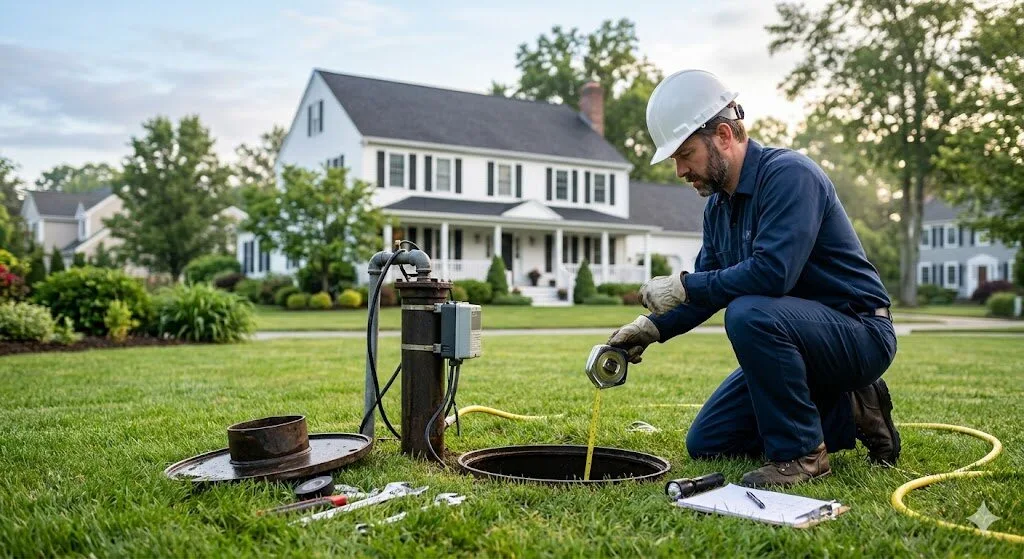
You drilled the well, installed the pump, and connected the water line. But do you actually know how much water is sitting inside that casing right now? Most homeowners never think about it until the pump starts sputtering or water pressure drops mid-shower.
This free well volume calculator tells you exactly how much water your well holds in gallons and litres. Enter your well diameter, total depth, and static water level and get a complete breakdown in seconds. No signup, no email, just an accurate number you can actually use.
Works for drilled wells, dug wells, dry wells, and rectangular cisterns.
Well Volume Calculator
Calculate casing volume, water column, annular space, and purge volume for water wells.
Well / Casing Dimensions
Output Settings
Water column = total depth − static water level
Results
How to Use This Well Volume Calculator
Getting your result takes less than a minute. Here is what each field means and where to find the numbers.
Step 1 — Select Your Well Type
Three options are available. Drilled well covers the standard circular steel or PVC cased wells common across Rhode Island and the Northeast. Dug well covers older rectangular or square wells. Dry well covers drainage and stormwater recharge structures.
If you are not sure which type you have, check your well completion report. Rhode Island Department of Environmental Management keeps records of all permitted wells drilled in the state. Your original driller filed a completion report within 30 days of finishing the job.
Step 2 — Enter Your Well Diameter
Enter the inside diameter of your well casing in inches or feet. Standard residential well casings in Rhode Island come in three common sizes.
A 4 inch casing is found in older installations and lower yield wells. A 6 inch casing is the most common size for residential drilled wells across Rhode Island. An 8 inch casing is used for high yield residential wells and most commercial installations.
One important detail here — use the inside diameter, not the outside measurement. A nominal 6 inch casing has an actual inside diameter of approximately 6.065 inches. That small difference affects your volume calculation, especially over long water columns.
Step 3 — Enter Total Well Depth
Total depth is measured from the ground surface at the top of the casing down to the very bottom of the well. This number is on your well completion report. If you cannot find that document, call your original driller or contact Rhode Island DEM to pull the record.
Do not guess this number. An incorrect total depth throws off the entire calculation and gives you a volume that is either overstated or understated.
Step 4 — Enter Static Water Level
This is the single most important measurement in the entire calculation. Static water level is the distance from the ground surface down to where the water begins inside the casing, measured when the pump has not run for at least one full hour.
When the pump is actively running, it pulls water out faster than the aquifer refills it. That gives you a lower reading called the dynamic water level. For volume calculation, always use the static reading taken during a period of no pumping activity.
How to measure it yourself: attach a weight to a measuring tape and lower it slowly into the well opening until you hear it touch water. The distance from the top of the casing to that point is your static water level.
Step 5 — Select Your Units
Choose feet or meters for length inputs. Choose gallons or litres for volume output. The calculator displays both gallons and litres simultaneously regardless of which unit you select as primary.
Step 6 — Read Your Results
Results include total water volume in gallons, total water volume in litres, water column height, total well volume if filled completely, and the percentage of the well currently holding water.
Well Volume Formula — How the Calculator Works
This calculator uses standard cylinder volume geometry. Understanding the formula helps you verify results and catch any input errors before relying on the number for real decisions.
Circular Well Volume Formula
For drilled wells with a circular casing, the equation works like this.
Water column height equals total well depth minus static water level depth.
Volume in cubic feet equals pi multiplied by the radius squared multiplied by the water column height.
Volume in gallons equals cubic feet multiplied by 7.48052.
Volume in litres equals cubic feet multiplied by 28.3168.
Written out:
Volume (gallons) = 3.14159 × (diameter ÷ 2)² × water column height × 7.48052
Sample Calculation
Take a standard 6 inch diameter well in Rhode Island. Total depth is 200 feet. Static water level measured at 80 feet from surface. That means the water column height is 120 feet.
Radius is 0.25 feet (3 inches converted to feet).
Volume = 3.14159 × (0.25)² × 120 = 23.56 cubic feet
Gallons = 23.56 × 7.48052 = 176 gallons
Litres = 23.56 × 28.3168 = 667 litres
That 6 inch well with 120 feet of water column holds 176 gallons or 667 litres of standing water at that moment.
Rectangular Well Volume Formula
For dug wells with a rectangular or square shape, the equation is simpler.
Volume in cubic feet equals length multiplied by width multiplied by water column height.
Volume in gallons equals cubic feet multiplied by 7.48052.
Gallons Per Foot — Quick Reference Table
If you know your well diameter and just want to estimate volume quickly, multiply gallons per foot by your water column height.
| Well Diameter | Gallons Per Foot |
|---|---|
| 4 inch | 0.65 gallons |
| 5 inch | 1.02 gallons |
| 6 inch | 1.47 gallons |
| 8 inch | 2.61 gallons |
| 10 inch | 4.08 gallons |
| 12 inch | 5.88 gallons |
A 6 inch well with 100 feet of water column holds 147 gallons. Double the water column to 200 feet and you have 294 gallons. The relationship is directly linear — every additional foot of water column adds 1.47 gallons to a standard 6 inch well.
Reference: These gallon per foot values are derived from standard cylinder volume calculations used by well drillers and published by the National Ground Water Association (NGWA) in their residential well system design guidelines.
How Much Water Does a Well Hold?
This is the question most homeowners actually want answered before anything else. The honest answer is that it depends entirely on your well diameter, the depth of your water column, and what the aquifer is doing on any given day.
Here is a practical reference table for common residential well configurations across the United States.
| Well Type | Diameter | Water Column | Volume in Gallons | Volume in Litres |
|---|---|---|---|---|
| Shallow drilled | 6 inch | 50 feet | 74 gallons | 280 litres |
| Standard drilled | 6 inch | 100 feet | 147 gallons | 556 litres |
| Deep drilled | 6 inch | 200 feet | 294 gallons | 1,113 litres |
| Large residential | 8 inch | 100 feet | 261 gallons | 988 litres |
| High yield commercial | 10 inch | 200 feet | 816 gallons | 3,089 litres |
| Dug well | 36 inch | 10 feet | 529 gallons | 2,003 litres |
One thing this table makes very clear — diameter matters far more than most homeowners realize. An 8 inch well holds nearly twice the water of a 6 inch well at the same depth. Moving from 6 inch to 10 inch diameter more than quintuples your stored volume.
That said, stored volume is only one piece of the picture. A well holding 300 gallons but replenishing at only 0.5 gallons per minute will run dry under normal household demand. Volume and yield work together — you need both numbers for a complete picture of your water supply.
Dry Well Volume Calculator
A dry well is a completely different structure from a drinking water well. It is an underground cylinder or chamber used to collect and slowly release stormwater, roof runoff, or greywater back into the surrounding soil and aquifer below. It does not supply water — it manages excess water.
The volume calculation uses the same cylinder equation, but the purpose is entirely different. For a dry well, you are calculating storage capacity for incoming water rather than measuring an existing water supply.
Dry Well Volume Formula
Volume in cubic feet equals pi multiplied by radius squared multiplied by depth.
A 4 foot diameter dry well sunk to 6 feet of depth holds approximately 75 cubic feet or 561 gallons of storage capacity before water begins to overflow or back up.
Rhode Island Dry Well Regulations
Rhode Island has specific stormwater management requirements for residential properties that install dry wells. The Rhode Island Department of Environmental Management and the Stormwater Solutions Manual published by Rhode Island DEM outline setback requirements, soil percolation testing requirements, and maximum volume specifications for residential dry well installations.
Dry wells in Rhode Island must generally be located at least 50 feet from any drinking water well, 25 feet from a septic system, and 10 feet from any property line. Soil percolation rates determine whether a dry well is even viable on a given property.
Resource: Rhode Island DEM Stormwater Solutions Manual — available at dem.ri.gov — covers dry well design, sizing, and installation requirements for residential properties.
Well Volume in Litres — Metric Calculation
The calculator above outputs both gallons and litres simultaneously. If you specifically need litre results for water treatment planning, Canadian property calculations, or international use, here are the key conversion values.
1 gallon equals 3.78541 litres.
1 cubic foot equals 28.3168 litres.
1 cubic metre equals 1,000 litres.
Quick Metric Reference
| Well Diameter | Water Column | Gallons | Litres |
|---|---|---|---|
| 6 inch (15 cm) | 50 feet (15 m) | 74 | 280 |
| 6 inch (15 cm) | 100 feet (30 m) | 147 | 556 |
| 6 inch (15 cm) | 200 feet (61 m) | 294 | 1,113 |
| 8 inch (20 cm) | 100 feet (30 m) | 261 | 988 |
Litres are the preferred unit for water treatment chemical dosing calculations. If you are planning shock chlorination, adding a water treatment chemical, or sizing a filtration system, working in litres often makes the dosing math simpler and reduces the chance of calculation errors.
Static Water Level vs Dynamic Water Level
Most volume calculation errors come from this one mistake — using the dynamic water level instead of the static water level.
Static water level is the depth to water measured when the pump has not run for at least one full hour. It represents the natural resting position of water in your well, reflecting the current state of the surrounding aquifer. This is the number to use in any volume calculator.
Dynamic water level is the depth to water measured while the pump is actively running. As the pump draws water out, the level drops below the natural static position. The difference between static and dynamic water level is called drawdown, and it tells you how hard the aquifer is working to refill the casing during active pumping.
For volume calculation, always use static water level. Using the dynamic level understates your actual water volume because it measures the depleted condition, not the full resting condition.
How to Measure Static Water Level Without Equipment
Stop all water use in the house. Wait a full hour. Open the well cap if accessible and lower a weighted measuring tape until it touches water. Note the distance from the top of the casing to the water surface. That is your static water level.
For a more accurate reading, a well sounder or electronic water level indicator gives precise results without guessing. These tools are available at most well supply and irrigation equipment suppliers.
Well Capacity vs Well Yield — An Important Distinction
These two terms get mixed up constantly, even in professional contexts. Understanding the difference matters for proper pump sizing, pressure tank selection, and daily water management.
Well volume (what this calculator measures) is the amount of water physically stored inside the well casing at any given moment. It is a snapshot of what is there right now, measured in gallons or litres.
Well yield is the rate at which new water flows into the well casing from the surrounding aquifer, measured in gallons per minute. It is not a snapshot — it is a flow rate that describes replenishment.
Well capacity is the practical combination of both — how much water you can draw from the well sustainably over a given time period without depleting it faster than the aquifer refills it.
Why Both Numbers Matter
A well with 300 gallons of stored volume and a yield of 3 GPM will comfortably serve a family of four. That same 300 gallons combined with a yield of 0.3 GPM will struggle to get through morning showers without running dry.
Rhode Island requires a minimum yield of 1 GPM for residential well approval under DEM regulations. Many wells in the state produce 2 to 5 GPM under normal aquifer conditions, with some high yield wells producing 10 GPM or more depending on the geology and depth.
Resource: National Ground Water Association — ngwa.org — publishes residential water use guidelines and minimum well yield standards that Rhode Island DEM incorporates into its well permitting framework.
Why Well Volume Calculation Matters — Real Use Cases
This is not just an academic exercise. Well volume is a number that comes up in several very practical situations that Rhode Island homeowners face regularly.
Shock Chlorination — How Much Bleach to Add
When your water test comes back positive for coliform bacteria or you suspect well contamination after a flood event, shock chlorination is the standard remediation treatment. The correct bleach dose depends entirely on knowing your well volume.
The standard treatment rate is 1 pint of unscented household bleach per 100 gallons of water in the well. A well with 200 gallons needs 2 pints. A well with 500 gallons needs 5 pints. Add too little and the treatment fails. Add too much and you have a chlorine problem that takes days of flushing to clear.
Rhode Island DEM recommends calculating three times the well casing volume when determining how much water to purge before collecting a water quality sample. That purging requirement makes accurate volume calculation essential for meaningful water testing results.
Sizing Your Pressure Tank
The pressure tank in your well system stores pressurized water between pump cycles. A well with low stored volume needs a larger pressure tank to compensate — otherwise the pump cycles on and off too rapidly, which overheats the motor and shortens its life dramatically.
A general rule used by well system contractors is that the pressure tank drawdown capacity should be at least equal to one minute of pump output. For a pump rated at 10 GPM, the tank needs at least 10 gallons of drawdown capacity. Well volume tells you whether your well can even support that demand before the pump starts pulling air.
Pump Selection and Drawdown
Choosing a pump that draws water faster than the aquifer refills the well is one of the most common and expensive mistakes in well system design. Once the pump draws the casing below the pump intake, it starts pulling air and sediment. That kills the pump and stirs up debris that can contaminate the water quality for weeks.
Well volume gives you the buffer time — how long you can pump at a given rate before reaching the pump intake depth. Pair that with your known yield in GPM and you have everything needed to set a safe pump rate that matches your aquifer.
Water Testing and Purging
Before collecting a water quality sample for laboratory analysis, the standard protocol requires purging three to five full casing volumes of water from the well. This removes stagnant water that has been sitting in the casing and ensures the sample reflects actual aquifer water rather than what has been sitting in the pipe.
Without an accurate volume calculation, you cannot purge correctly. Underpurging gives you a sample that reflects casing water, not groundwater. Overpurging wastes time and may stress a low yield well unnecessarily.
Well Abandonment and Plugging
When a well is decommissioned in Rhode Island, DEM regulations require filling the entire well casing with bentonite grout or other approved sealant material to prevent surface contaminants from reaching the groundwater below. The amount of grout material needed depends directly on the total well volume — the calculation you can do right here.
Drought and Water Conservation
During Rhode Island dry summers, groundwater levels in shallow aquifers can drop significantly. Knowing your normal static water level and calculating current volume during a drought tells you exactly how much buffer you have before the pump starts drawing from the bottom of the casing. That gives you time to reduce usage proactively rather than reacting to a dry well emergency.
Volume of Water Calculator — Gallons and Litres Conversion Reference
| Measurement | Gallon Equivalent | Litre Equivalent |
|---|---|---|
| 1 cubic foot | 7.48 gallons | 28.32 litres |
| 1 cubic metre | 264.17 gallons | 1,000 litres |
| 1 gallon | 1 gallon | 3.785 litres |
| 1 litre | 0.264 gallons | 1 litre |
This well volume calculator gives Rhode Island homeowners and property owners across the United States a fast, accurate way to determine exactly how much water their well holds in gallons and litres. Whether you are planning shock chlorination, sizing a pressure tank, preparing a water quality sample, or simply monitoring your water supply during a dry summer, starting with an accurate volume calculation makes every next step more reliable. Use the results here alongside your well yield data and consult a licensed well contractor in Rhode Island for any system changes or concerns about your water supply.
External References:
- National Ground Water Association (NGWA) — ngwa.org — residential well system design guidelines
- Rhode Island DEM Well Records — dem.ri.gov — well completion reports and permitting
- Rhode Island DEM Stormwater Solutions Manual — dry well installation requirements
- US Geological Survey (USGS) — usgs.gov — groundwater level monitoring and aquifer data
How much water does a well hold?
A standard 6 inch drilled well with 100 feet of water column holds approximately 147 gallons or 556 litres of standing water. Total volume depends on your specific well diameter, depth, and current static water level. Use the calculator above with your actual measurements for a precise figure.
How do I calculate well volume?
Multiply pi (3.14159) by the square of your well radius in feet, then multiply that result by your water column height in feet. Multiply the answer by 7.48052 to get gallons or by 28.3168 to get litres. The calculator above does all of this automatically once you enter diameter, total depth, and static water level.
How many gallons per foot does a 6 inch well hold?
A 6 inch well casing holds approximately 1.47 gallons per foot of water column. For 50 feet of water column that is 74 gallons. For 200 feet that is 294 gallons.
What is a drywell calculator used for?
A drywell calculator estimates the storage capacity of a dry well — an underground drainage structure used for stormwater or greywater recharge. The same cylinder volume formula applies but the purpose is managing incoming water, not supplying drinking water. Rhode Island properties using dry wells must comply with DEM setback and soil percolation requirements.
How do I find my static water level?
Stop all water use and wait at least one hour. Lower a weighted measuring tape into the well casing until it makes contact with the water surface. The distance from the ground surface to that point is your static water level. For precision, an electronic water level indicator gives more consistent readings.
What is the difference between well volume and well yield?
Well volume is the amount of water currently stored inside the casing, measured in gallons or litres. Well yield is the rate at which new water flows into the well from the surrounding aquifer, measured in gallons per minute. Both figures are needed to properly size a pump and pressure tank.
How do I convert my well volume from gallons to litres?
Multiply gallons by 3.78541 to get litres. A well holding 200 gallons contains 757 litres. A well holding 500 gallons contains 1,893 litres.
What happens if I pump my well below the pump intake?
The pump begins drawing air instead of water, which causes the motor to overheat and can burn out the pump entirely. In some wells it also stirs up sediment from the bottom of the casing, affecting water quality for an extended period. Knowing your well volume and yield lets you set a pumping rate that avoids this.