Drilling a water well in Florida typically costs between $1,500 and $12,000 for a complete residential installation. Florida wells are significantly shallower than most states — most residential wells reach water at 50 to 200 feet — which keeps drilling costs well below the national average. Total costs depend on well type, target aquifer, county regulations, water management district requirements, and whether a submersible pump and pressure tank are included in the quote. Florida’s sandy limestone geology makes drilling faster and less expensive per foot than hard rock states like Arizona or New England granite country.
| Cost Factor | Low Estimate | High Estimate |
|---|---|---|
| Drilling per foot | $8 | $20 |
| Average well depth | 50 ft | 200 ft |
| PVC well casing | $500 | $2,000 |
| Submersible pump | $800 | $2,500 |
| Pressure tank | $400 | $1,200 |
| FDEP or county permit | $100 | $600 |
| Water quality testing | $150 | $500 |
| Total Complete System | $1,500 | $12,000 |
Average Cost to Drill a Well in Florida — Full Breakdown
Florida is one of the most affordable states in the country when it comes to water well drilling costs. The national average per foot drilling rate runs $15 to $25. In Florida, most well drilling contractors charge $8 to $20 per foot, with the lower end of that range common in north and central Florida where soft limestone drilling moves fast and equipment wear is minimal.
The depth of the well is the primary cost driver for any Florida water well project, just as it is in every other state. A 60 foot irrigation well at $12 per foot costs $720 in drilling alone. A 200 foot residential Floridan Aquifer well at the same rate costs $2,400 in per foot drilling costs before you add casing, submersible pump, pressure tank, electrical hookup, grouting, water testing, and permit fees. The complete well system cost in that second scenario runs $6,000 to $9,000 total depending on your county and the contractor you hire.
What makes Florida different from most states is how quickly and reliably you reach water. The Floridan Aquifer System is one of the most productive aquifer systems in the world, and it runs beneath virtually the entire state. In Marion County and much of north central Florida, a well driller can hit the Upper Floridan Aquifer at 80 to 160 feet. In Central Florida near Orlando, water is often found at 100 to 180 feet. Even in south Florida where the geology is more complex, water is rarely more than 300 feet away. That accessibility keeps drilling time short, equipment costs lower, and overall project costs more manageable for the average Florida homeowner.
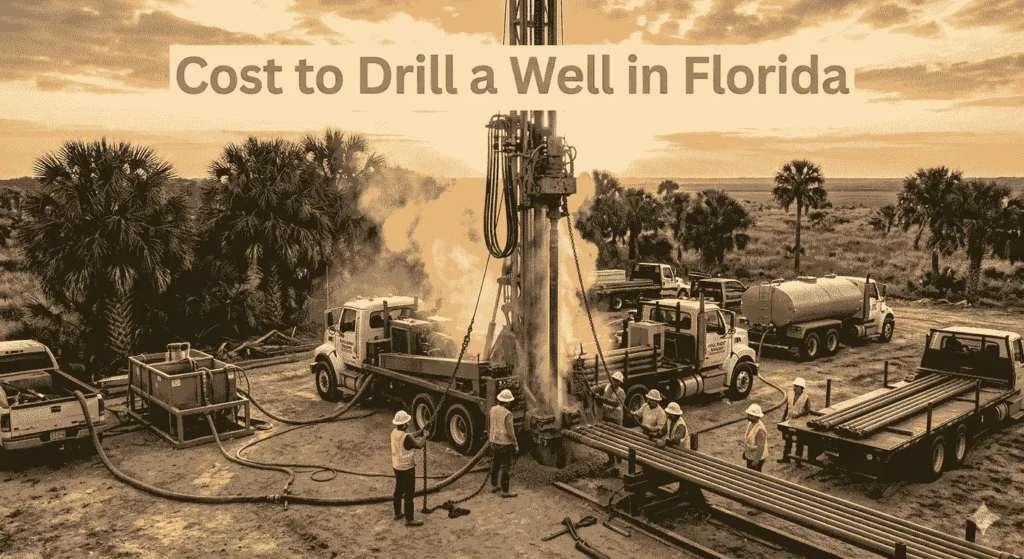
Florida Well Drilling Cost Per Foot — Why It Is More Affordable Than Most States
Florida sits almost entirely on a foundation of limestone karst covered by sand and clay. Limestone drills significantly faster than granite, basalt, or schist. While a well drilling crew in Arizona or New Hampshire might penetrate 5 to 15 feet of hard rock per hour, a Florida drilling crew working through sandy overburden and soft limestone can advance 50 to 100 feet per hour under good conditions. That speed difference is the single biggest reason Florida well drilling costs are lower than the national average on a cost per foot basis and dramatically lower on a total project cost basis.
Labor rates are also competitive in Florida. The state has a large and experienced pool of licensed well drilling contractors working across every county. That competition keeps pricing reasonable in a way that more rural states with fewer licensed drillers cannot match. In a rural Arizona county or parts of the rural Northeast, you might have 2 or 3 drilling companies serving an entire county. In Alachua County or Marion County, Florida, you have a dozen or more licensed contractors actively competing for residential water well projects.
One cost variation worth understanding is mobilization. Florida’s flat terrain and good road access across most of the state keep equipment transport costs low. A drilling company moving a rig from Ocala to a rural property in Levy or Putnam County faces none of the access challenges common in mountainous or heavily forested states. That keeps the total cost of your drilling project lower from the very first line on the quote.
What Is Included in a Complete Florida Water Well System
A complete water well system in Florida includes considerably more than drilling a hole in the ground. Here is the full scope of what a properly installed residential well involves from start to finish.
The process begins with a site assessment where your well drilling contractor reviews nearby well completion reports from the FDEP database to estimate the target aquifer depth on your specific parcel. Second is the permit application submitted to your county health department as the delegated agent of the Florida Department of Environmental Protection. Third is the actual drilling using a rotary or cable tool rig appropriate for Florida’s limestone geology. Fourth is the installation of PVC well casing, which lines the borehole from the surface down to the first producing zone and protects the water source from surface contamination. Fifth is grouting between the casing and the borehole wall, which is required by Florida well construction standards to prevent shallow groundwater from migrating down along the outside of the casing. Sixth is well development where the contractor pumps water through the new well to clear drilling debris and assess water yield. Seventh is submersible pump installation at depth, connecting the pump to the surface with drop pipe and electrical wire. Eighth is pressure tank and plumbing installation at the surface. Ninth is electrical connection and controls. Tenth is water quality testing for bacteria, nitrates, hardness, iron, and any contaminants of concern specific to your area. Eleventh is the final inspection and permit closeout required by Florida law.
Well Drilling Costs in Florida by County and Region
Florida’s regional cost variation is real and meaningful. A well drilled in Marion County over the highly productive Floridan Aquifer costs less and drills faster than a well in a South Florida county where greater depth and saltwater intrusion concerns add complexity and cost. Here is what homeowners across the state typically pay based on location.
| County | Typical Depth | Cost Range | Notes |
|---|---|---|---|
| Marion (Ocala) | 80 to 200 ft | $2,500 to $8,000 | Floridan aquifer, excellent water quality |
| Orange (Orlando) | 50 to 180 ft | $2,000 to $7,500 | Surficial and Floridan both available |
| Hillsborough (Tampa) | 60 to 180 ft | $2,500 to $8,000 | Saltwater intrusion risk near coast |
| Alachua (Gainesville) | 100 to 250 ft | $3,000 to $9,000 | Karst terrain, sinkhole risk zones |
| Polk (Lakeland) | 80 to 200 ft | $2,500 to $8,000 | Phosphate mining history in some areas |
| Volusia (Daytona) | 60 to 160 ft | $2,000 to $7,000 | Coastal salinity monitoring required |
| Lake County | 70 to 180 ft | $2,500 to $7,500 | High lake density, shallow water table |
| Hernando | 80 to 180 ft | $2,500 to $7,500 | Springs coast, high water table |
| Citrus | 80 to 200 ft | $2,500 to $8,000 | Springs area, reliable Floridan access |
| Putnam | 100 to 200 ft | $2,500 to $8,000 | Rural, competitive pricing |
Well Drilling Costs in Central Florida
Central Florida is the most active residential well drilling market in the state. The Orlando metro’s continued sprawl into Osceola, Lake, and western Orange County is pushing new development into areas where municipal water service either does not reach or comes with prohibitive connection fees. Private well installation is frequently the more practical and affordable water solution for these homeowners.
The Central Florida well drilling market offers two distinct paths depending on your water use. For homeowners who need water only for a sprinkler system or irrigation well for lawn and landscaping, a shallow surficial aquifer well at 40 to 80 feet is the fastest and least expensive option, typically costing $1,500 to $4,000 complete. The surficial aquifer in Central Florida is reliable for irrigation purposes and drilling time is minimal — most shallow wells in this category are completed in a single day.
For homeowners who need the well as their primary water source for residential use, a Floridan Aquifer well is the right choice despite the higher upfront cost. The St. Johns River Water Management District, which governs most of Central Florida’s groundwater, processes residential well permits through county health departments. Permit turnaround in Orange, Lake, and Osceola counties typically runs 2 to 4 weeks for standard residential applications.
One thing Central Florida homeowners consistently underestimate is water treatment costs. The surficial aquifer throughout the Orlando metro area is high in iron, tannins, and organic matter. Water coming from a shallow well in this region often runs brown or orange due to dissolved iron and tannin content. A water treatment system including an iron filter and water softener adds $800 to $2,000 to your overall project cost but is essentially non-optional for households using this water for drinking and bathing. Even Floridan Aquifer water in Central Florida frequently tests high for hardness and sometimes iron, making a water softener a practical addition to the complete well system.
Cost of Drilling a Well in Marion County Florida
Marion County is one of the best locations in Florida to drill a private well. The county sits directly over the Upper Floridan Aquifer, one of the most productive and reliable aquifer systems in the world, and most Marion County properties can reach excellent quality water at depths of 80 to 200 feet. That combination of accessible depth and outstanding water quality makes Marion County among the most cost-effective well drilling markets in the entire state.
Average total cost for a complete residential well installation in Marion County runs $2,500 to $8,000 depending on depth, pump selection, and whether a water treatment system is needed. Drilling contractors in the Ocala area are numerous and competitive, which keeps pricing reasonable. The Marion County Health Department processes FDEP delegated well construction permits with fees in the $100 to $300 range for standard residential applications.
Water quality in Marion County wells is generally excellent compared to many other Florida counties. The Floridan Aquifer delivers naturally filtered limestone water that is cold, clear, and often requires only a water softener to address hardness before use as a complete residential drinking water system. The same aquifer feeds Silver Springs, Rainbow Springs, and the Ocklawaha River corridor, all iconic north-central Florida natural landmarks. Iron content can be elevated in some Marion County Floridan wells, particularly in the shallower zones, but a basic iron filter handles this effectively at modest cost.
Rural properties in the eastern part of Marion County near the Ocala National Forest sometimes encounter deeper drilling requirements and slightly higher per foot costs due to the forest’s different geological characteristics compared to the main Ocala basin. Overall, Marion County remains one of the most straightforward and affordable well drilling markets in the state.
Well Drilling Costs in South Florida
South Florida’s well drilling market differs significantly from the rest of the state. The Miami-Dade, Broward, and Palm Beach corridor has extremely high municipal water coverage and relatively few private residential wells for drinking water. Where private wells do exist in coastal South Florida, they are primarily used for irrigation systems rather than residential water supply.
The primary reason is saltwater intrusion. South Florida sits at or very near sea level, and decades of groundwater pumping combined with rising sea levels have pushed saltwater progressively further inland into the Biscayne Aquifer, which is the primary shallow aquifer in Miami-Dade and Broward counties. Drilling a drinking water well in coastal areas of these counties risks hitting brackish or fully saline water that is unsuitable as a water source for residential use without expensive desalination treatment.
Inland South Florida including western Miami-Dade, rural Collier County, and Hendry County is different. Properties in agricultural and rural areas west of the urban coastal corridor can still access reliable fresh groundwater from the Floridan Aquifer at depths of 150 to 300 feet. Well drilling costs in these areas run $5,000 to $12,000 for a complete residential system. The South Florida Water Management District has additional permit requirements and consumptive use thresholds that add time and occasionally cost to the well construction permit process compared to north and central Florida.
Florida Specific Factors That Affect Well Drilling Cost
Florida’s Three Aquifer Systems and How They Drive Cost Variations
Understanding Florida’s aquifer systems is the foundation of understanding why well drilling costs vary significantly by location and purpose across the state.
The Surficial Aquifer System sits closest to the surface at 20 to 80 feet in most of Florida. It is the least expensive to reach and the fastest to drill. However surficial aquifer water is typically not suitable for drinking without treatment due to elevated iron, tannins, bacteria risk from shallow depth, and nitrates in agricultural areas. The surficial aquifer is the standard choice for irrigation well installation, sprinkler system wells, and agricultural water use. Cost to install a complete surficial irrigation well: $1,500 to $4,000.
The Intermediate Aquifer System exists primarily in southwest Florida, particularly in Sarasota, Charlotte, Lee, and Collier counties. It sits between the surficial system and the Floridan at depths of 80 to 200 feet in this region. Water quality is better than surficial but variable. Cost to install a complete intermediate aquifer well: $3,000 to $7,000.
The Floridan Aquifer System is the deep limestone aquifer that runs beneath virtually the entire state of Florida and into parts of Georgia, South Carolina, and Alabama. It is one of the largest and most productive aquifers in the world. Floridan Aquifer wells in Florida typically run 100 to 400 feet depending on location, with shallower access in north and central Florida and deeper requirements in parts of south Florida. Water quality from the Floridan is generally excellent, naturally filtered through limestone, and suitable as a complete residential drinking water source with standard treatment for hardness and occasionally iron. Cost to install a complete Floridan Aquifer residential well: $4,000 to $12,000.
Florida Water Management Districts and Permit Costs
Florida divides water resource management across five regional Water Management Districts, each with its own permit requirements, fees, and regulatory priorities. Knowing which district governs your property is an essential first step before beginning any well drilling project.
The Northwest Florida Water Management District covers the Panhandle region from Pensacola to just west of the Suwannee River. The Suwannee River Water Management District covers north central Florida including Columbia, Hamilton, Madison, and Suwannee counties. The St. Johns River Water Management District is the largest by area and covers northeast and most of central Florida including the entire Orlando metro, Daytona Beach corridor, and northeast coast. The Southwest Florida Water Management District, widely known as Swiftmud, covers the Tampa Bay region, Sarasota, Fort Myers, and the Withlacoochee corridor. The South Florida Water Management District covers everything south of Lake Okeechobee including the Everglades, Miami-Dade, Broward, and Palm Beach counties.
For most residential well permits in Florida, the practical contact is your county health department, which processes well construction permits as a delegated agent of FDEP. Residential well construction permit fees run $100 to $600 depending on county. South Florida Water Management District adds consumptive use permit requirements for wells exceeding certain daily withdrawal thresholds, which can add $200 to $500 and several additional weeks to the permit process for larger systems.
Florida Well Types and What Each Costs
Not every Florida homeowner needs the same type of well. The right well type depends on whether you need water for irrigation only, residential water supply, or both. The type of well determines the target depth, casing requirements, pump selection, and ultimately the total project cost.
| Well Type | Target Depth | Total Cost Range | Best Use |
|---|---|---|---|
| Shallow irrigation well | 20 to 80 ft | $1,200 to $4,000 | Sprinkler system, lawn irrigation |
| Intermediate residential well | 80 to 200 ft | $3,000 to $7,500 | Mixed use, southwest Florida |
| Deep Floridan drinking water well | 150 to 400 ft | $5,000 to $12,000 | Primary residential water supply |
| Geothermal well | 150 to 300 ft | $8,000 to $20,000 | HVAC ground loop systems |
| Agricultural irrigation well | 60 to 200 ft | $3,000 to $15,000 | Large volume farm or ranch use |
Florida Water Quality Issues That Add to Total Cost
Water quality is the most commonly underestimated additional cost in any Florida well drilling project. The geology that makes Florida an easy state to drill in also creates predictable water quality challenges that most homeowners encounter after the well is installed and producing water.
Iron is the most widespread issue across north and central Florida. Naturally occurring iron in the Floridan Aquifer causes orange or rust-colored staining on fixtures, toilets, and laundry within weeks of putting a new well into service without treatment. An iron filter installed at the pressure tank removes this effectively and costs $600 to $1,500 installed.
Hard water is essentially universal in Florida. The Floridan Aquifer passes through limestone and picks up calcium and magnesium as it travels underground for thousands of years. That mineral content makes Florida well water extremely hard, causing scale buildup in water heaters, dishwashers, washing machines, and pipes. A water softener is the standard solution and costs $800 to $2,000 installed.
Hydrogen sulfide, which produces the characteristic rotten egg smell, is common in certain areas of central and southwest Florida. It is treatable with an aeration system or oxidizing filter. Tannins from organic material produce a tea-brown color in many north Florida shallow wells. Nitrates are a concern in agricultural counties including Alachua, Marion, Levy, Columbia, and Suwannee where fertilizer and septic systems have impacted groundwater over decades. Saltwater intrusion affects coastal counties from Brevard south through Miami-Dade and along the southwest coast from Sarasota to Collier.
Building the cost of water treatment into your well project budget from the beginning rather than discovering the need six months after installation is the most financially practical approach. Most experienced Florida well drilling contractors will tell you upfront what the common water quality challenges are in your specific area.
Sinkhole Risk in Florida and Its Effect on Well Drilling
Florida’s karst limestone geology creates one of the most active sinkhole environments in the United States. The same limestone formations that make drilling fast and affordable also contain underground voids and cavities that can create sinkholes when they collapse. Well drilling in high sinkhole risk areas requires additional care and expertise to avoid drilling into unknown voids that could compromise the well structure.
The highest sinkhole frequency in Florida runs through a band from Alachua County south through Polk and into Hillsborough County, roughly following the Floridan Aquifer’s most productive zone. Marion, Citrus, and Hernando counties also have significant sinkhole activity. Drilling contractors working in these areas use drilling mud and careful monitoring to detect void zones before penetrating them.
Some counties require sinkhole risk disclosure for properties and may add geological assessment requirements to well construction permits in high risk zones. The additional assessment typically costs $300 to $800 but protects the homeowner from a failed well installation in a compromised location.
What We Have Seen Working in Florida’s Well Market
Florida is the most accessible well drilling market we work in from a geology standpoint. When a drilling crew completed a residential Floridan Aquifer well in Ocala last summer, they hit limestone at 40 feet and reached the producing zone at 160 feet. Total drilling time was less than two days. The complete well system including submersible pump, pressure tank, and water testing came in at $5,800 — a number that would be impossible to achieve in Arizona hard rock country or against New England granite.
That said, Florida has its own complexity that cheap online cost estimators never account for. The same Marion County property that drills easily at $5,800 may need a $1,400 iron filtration and water softener system because the Floridan Aquifer in that specific area runs high in dissolved iron and hardness. The water comes out of the ground cold and clear but it stains fixtures within weeks without treatment. That is not a drilling cost — it shows up six months after the well is installed.
In Central Florida near the Orlando metro, we consistently see homeowners surprised by the gap between the first quote they received and what actually gets drilled. A contractor quoting a 60 foot surficial aquifer well in Orange County is technically offering an accurate price but that water is not suitable for residential use without serious treatment. A proper Floridan Aquifer well in the same location runs 180 to 200 feet and costs twice as much upfront but delivers clean, reliable water that can last the life of the property with basic maintenance. The depth of the well matters enormously in Florida and it is the first question every homeowner should ask before accepting any quote from any well drilling contractor.
One thing we tell every Florida homeowner considering drilling a private well: check the FDEP well completion report database before calling a single contractor. Florida maintains one of the best publicly accessible well completion databases in the country. You can look up every permitted well drilled within a mile of your property, see the exact depth, the aquifer tapped, the water yield in gallons per minute, and the casing specifications. That information sets realistic depth expectations and gives you a powerful negotiating tool when comparing quotes from multiple drilling services.
Private Well vs Municipal Water in Florida — Real Cost Comparison
Florida has the largest private well population of any state in the country with approximately 1.7 million registered private wells according to FDEP data. That number reflects the reality that large parts of rural and semi-rural Florida simply do not have access to city water service and never will given the cost of extending municipal infrastructure to low-density areas.
For homeowners who do have a choice between connecting to municipal water and drilling a private well, the financial comparison is worth running carefully. Municipal water connection fees in Florida typically run $2,000 to $10,000 paid to the utility district as a one-time tap-in fee, followed by monthly water bills averaging $40 to $90 for typical residential use. Over 20 years that represents $9,600 to $21,600 in monthly bills on top of the connection fee — a total of $11,600 to $31,600 in water costs.
A complete private well installation in the same area costs $3,000 to $12,000 upfront with near zero ongoing costs beyond annual water quality testing at $150 to $300 per year and pump maintenance or replacement every 10 to 20 years. The break-even point for most Florida residential properties falls between 5 and 10 years when comparing total cost of ownership over the life of the property.
Beyond the financial calculation, an independent water well provides water pressure and supply that is not subject to utility rate increases, drought-driven restrictions, or system outages. For a property that plans to remain in the family for generations, a private well is a sustainable water solution that pays for itself many times over during its serviceable life. A properly constructed Florida Floridan Aquifer well can last 30 to 50 years with proper maintenance before requiring any significant rehabilitation work.
For homeowners using their private well to feed a sprinkler system or irrigation system for a large lawn or agricultural use, the savings compared to irrigating with metered municipal water are even more dramatic. Irrigation use is the single largest component of residential water consumption in Florida and watering a lawn with city water in the summer months can add $100 to $300 per month to a water bill. An irrigation well eliminates that cost entirely.
How to Get an Accurate Well Drilling Quote in Florida
Knowing how to evaluate quotes from Florida well drilling contractors saves money and prevents surprises. The process is straightforward if you follow these steps in order.
Step one is checking the FDEP well completion report database before contacting any contractor. The database is publicly available at floridadep.gov and shows every permitted well near your property. Use those records to establish realistic depth expectations for your specific location.
Step two is identifying your county’s water management district and checking whether your property falls in any special permit area, sinkhole risk zone, or saltwater intrusion advisory area.
Step three is getting a minimum of three quotes from licensed Florida well drilling contractors. License verification is quick and free through the Florida Department of Business and Professional Regulation at myfloridalicense.com.
Step four is confirming in writing that every quote includes all system components: drilling per foot, PVC well casing, grouting, submersible pump, pressure tank, electrical hookup, FDEP permit fee, water quality testing, and final inspection. Any contractor who quotes only the drilling and excludes these other components is giving you a misleading number.
Step five is asking the contractor specifically about water quality in your area and whether a water softener, iron filter, or other water treatment equipment will be needed.
| What to Confirm | Basic Quote | Complete Quote |
|---|---|---|
| Drilling per foot rate | ✅ | ✅ |
| PVC casing included | ❌ | ✅ |
| Submersible pump | ❌ | ✅ |
| Pressure tank | ❌ | ✅ |
| FDEP or county permit | ❌ | ✅ |
| Water quality testing | ❌ | ✅ |
| Water treatment recommendation | ❌ | ✅ |
| Grouting and seal | ❌ | ✅ |
| Final permit inspection | ❌ | ✅ |
Frequently Asked Questions — Well Drilling Cost Florida
How much does it cost to drill a well in Florida?
Drilling a water well in Florida costs between $1,500 and $12,000 for most residential installations. The wide range reflects the difference between a shallow 50 foot irrigation well at the low end and a deep 300 foot Floridan Aquifer drinking water well with full pump and water treatment system at the high end. Florida drilling costs vary significantly less than most states because the geology is consistently favorable for drilling across nearly the entire state.
How deep does a well need to be in Florida?
Well depth in Florida depends on the target aquifer and your location. Shallow surficial aquifer wells reach water at 20 to 80 feet and are used primarily for irrigation. Floridan Aquifer wells used as a residential water source typically run 100 to 300 feet depending on county. Marion County and north central Florida commonly reach the Upper Floridan Aquifer at 80 to 160 feet. South Florida wells may need 200 to 400 feet to reach fresh water while avoiding saltwater intrusion in coastal areas.
What is the cost of drilling a well in Central Florida?
Well drilling costs in Central Florida including Orange, Lake, Osceola, and Polk counties typically run $2,000 to $8,000 for a complete residential installation. Surficial aquifer irrigation wells in the 50 to 80 foot range cost $1,500 to $4,000. Floridan Aquifer residential wells in the 150 to 250 foot range cost $4,500 to $9,000 including submersible pump and pressure tank. Most Central Florida homeowners who need a new well drilled for residential water supply choose the Floridan option despite the higher upfront investment.
What is the cost of drilling a well in Marion County Florida?
Marion County well drilling typically costs $2,500 to $8,000 for a complete Floridan Aquifer residential installation. Marion County sits directly over the Upper Floridan Aquifer and most properties reach excellent quality water at 80 to 200 feet. County health department permits run $100 to $300. Water treatment for iron and hardness is commonly recommended and adds $600 to $1,500 to the overall system cost.
Do you need a permit to drill a well in Florida?
Yes. Florida requires a well construction permit issued through FDEP or the applicable Water Management District before any drilling begins. Most residential well permits are processed through county health departments as delegated agents. Permit fees range from $100 to $600 depending on county. Florida state law prohibits drilling without a permit and violations can result in fines and orders to abandon the unpermitted well.
How long does it take to drill a well in Florida?
Active drilling in Florida typically takes 1 to 3 days for a standard residential well due to the state’s soft limestone and sand geology. Permit approval through the county health department adds 1 to 4 weeks before drilling can legally begin. Total project timeline from permit application to running water in the home averages 3 to 6 weeks. Florida wells are completed significantly faster than hard rock states where drilling alone can take a full week.
Is Florida well water safe to drink?
Florida well water safety depends on the aquifer tapped and your property location. Floridan Aquifer water is generally high quality but typically hard and sometimes contains elevated iron or sulfur. Surficial aquifer water frequently contains iron, tannins, bacteria, and nitrates that require treatment before residential use. FDEP recommends annual water quality testing for all private well owners. A water softener, iron filter, or reverse osmosis system is commonly needed and adds $600 to $2,000 to total system costs depending on your specific water quality results.
How long does a Florida water well last?
A properly constructed Florida Floridan Aquifer well can provide reliable water service for 30 to 50 years with appropriate maintenance. The submersible pump typically needs replacement every 10 to 20 years at a cost of $800 to $2,000 including labor. The well casing and borehole itself, when properly grouted and sealed at installation, lasts the life of the property in most Florida geological conditions. Annual water quality testing and periodic inspection by a licensed well service contractor keeps the system performing optimally throughout its serviceable life.
References and Sources
- Florida Department of Environmental Protection — Water Well Permitting floridadep.gov/water/water-resource-management/content/water-well-program
- FDEP Well Completion Report Database — Florida Well Search ca.dep.state.fl.us/mapdirect
- St. Johns River Water Management District — Well Permitting sjrwmd.com/resources/permitting-licensing
- Southwest Florida Water Management District (Swiftmud) — Water Use Permits watermatters.org/permits
- South Florida Water Management District — Groundwater Resources sfwmd.gov/our-work/groundwater
- U.S. Geological Survey — Floridan Aquifer System pubs.usgs.gov/circ/circ1083
- Florida Department of Business and Professional Regulation — Well Contractor License Verification myfloridalicense.com
- Marion County Health Department — Environmental Health Well Permitting marionchd.com/environmental-health
- Florida Geological Survey — Karst and Sinkhole Information floridadep.gov/fgs
- EPA Safe Drinking Water — Private Well Owner Resources epa.gov/privatewells
- National Ground Water Association — Well Drilling Cost Data by State ngwa.org
- HomeAdvisor — Well Drilling Cost Florida 2025 to 2026 homeadvisor.com/cost/plumbing/dig-a-well
- University of Florida IFAS Extension — Private Water Systems in Florida edis.ifas.ufl.edu
ajwellri.com provides well drilling cost information and contractor referral services for Florida, Rhode Island, Massachusetts, and New England. All cost estimates reflect 2026 market conditions and are provided for informational purposes. Contact a licensed Florida well drilling contractor for a site-specific quote for your property.