Drilling a water well in Arizona typically costs between $15 and $30 per foot, with most residential wells running 300 to 800 feet deep depending on location. Total project costs range from $5,000 to $25,000 or more, factoring in casing, pump installation, and permits. Arizona’s desert geology including hard granite formations in Maricopa and Yavapai counties significantly impacts drilling time and overall cost. Arizona Department of Environmental Quality (ADEQ) permit fees and county specific regulations add $500 to $2,000 to the total investment for most homeowners.
| Cost Factor | Low Estimate | High Estimate |
|---|---|---|
| Drilling per foot | $15 | $30 |
| Average well depth | 300 ft | 800 ft |
| Casing installation | $1,000 | $3,500 |
| Pump and pressure tank | $1,500 | $4,000 |
| ADEQ permit | $200 | $2,000 |
| Water quality testing | $200 | $800 |
| Total Project Cost | $5,000 | $25,000+ |
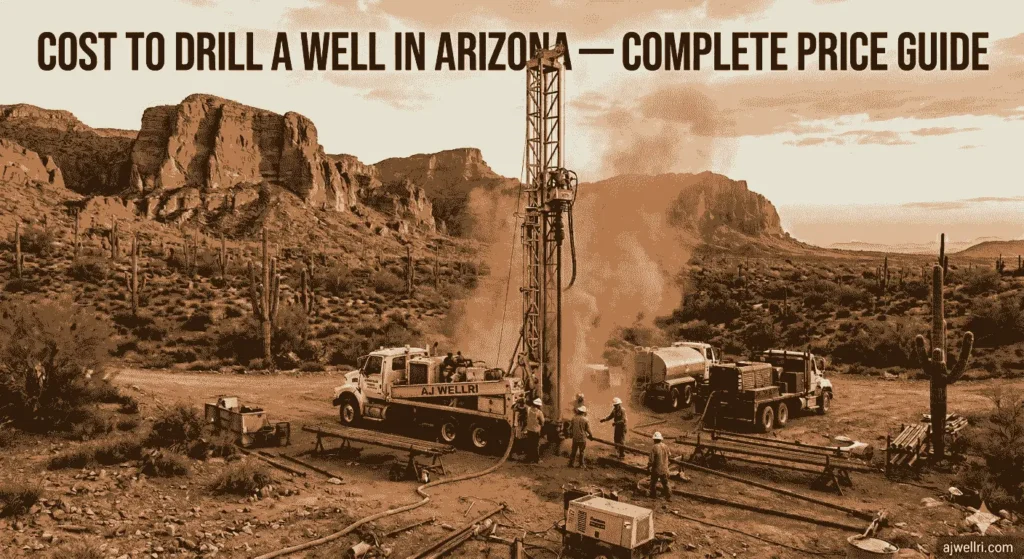
Average Cost to Drill a Well in Arizona — Full Breakdown
Arizona well drilling costs run higher than the national average for good reason. The national average for water well drilling sits at $15 to $25 per foot. In Arizona, most drilling contractors charge $15 to $30 per foot, with some hard rock drilling services in Yavapai and Coconino counties reaching $35 per foot or more. The Sonoran Desert bedrock including granite, basalt, and schist requires specialized tri-cone or PDC drill bits that wear down faster than in softer soil states, which adds 15 to 25 percent to overall drilling time and labor costs.
The depth of the well is the single biggest cost driver for any Arizona water well project. A 400 foot well at $20 per foot costs $8,000 in drilling alone before you add casing, pump, pressure tank, electrical hookup, and permits. A 700 foot well at the same rate costs $14,000 in drilling costs alone. Add the full system components and you are looking at $18,000 to $24,000 for a deep rural Arizona water well installation.
Mobilization costs are another factor most drilling companies leave out of initial quotes. Getting a drilling rig to a remote property in rural Yavapai, Mohave, or Coconino County can add $500 to $2,500 to your final bill depending on road access and distance from the contractor’s base of operations.
Arizona Well Drilling Cost Per Foot — Why It Costs More Than the National Average
Arizona sits on three distinct geological zones that each affect drilling costs differently. The Basin and Range province covers Phoenix, Tucson, and most of southern Arizona. It has alluvial sediment in valley floors but transitions quickly to hard granite in the surrounding mountain ranges. The Colorado Plateau covers Flagstaff, Sedona, and the northeastern corner of the state, where sandstone and limestone create moderate drilling difficulty. The Transition Zone running through Prescott, Globe, and the White Mountains is mixed hard rock and consistently produces the highest drilling costs in the state.
Beyond geology, extreme summer heat pushing 115 degrees Fahrenheit in the Phoenix metro slows equipment operation and increases fuel consumption for the drilling contractor. Arizona water tables have also dropped significantly in many areas due to 25 years of prolonged drought conditions and population growth, meaning new well installation requires drilling deeper than it did a decade ago to reach reliable water levels.
What Is Included in the Total Cost of Drilling a Water Well in Arizona
A complete water well system in Arizona includes more than just drilling a hole in the ground. Here is what a full installation covers from start to finish:
First comes the site assessment where your drilling contractor reviews soil reports and nearby well logs from the ADEQ Wells 55 database to estimate target depth. Second is the ADEQ permit application, which is legally required before any residential drilling begins. Third is the actual drilling to target depth using a rotary drill rig appropriate for Arizona’s geology. Fourth is the well casing installation, either steel or PVC, which lines the borehole and protects the water source from surface contamination. Fifth is gravel packing and grouting around the casing to seal the well properly. Sixth is well development where the contractor pumps water through the new well to clear drilling debris and assess water yield. Seventh is pump installation, pressure tank setup, and electrical hookup. Eighth and finally is water quality testing to check for naturally occurring contaminants including arsenic, uranium, and nitrates that are common in Arizona groundwater.
Well Drilling Costs by County in Arizona
Arizona’s regional cost variation is significant. A well drilled in Tucson’s alluvial basin costs meaningfully less than the same well drilled in the granite highlands of Prescott. Here is what well owners across the state actually pay based on county and typical geological conditions.
| County | Average Depth | Typical Cost Range | Geology |
|---|---|---|---|
| Maricopa (Phoenix) | 400 to 600 ft | $9,000 to $18,000 | Hard granite, high demand |
| Pima (Tucson) | 250 to 450 ft | $6,500 to $14,000 | Sandy alluvial basin |
| Yavapai (Prescott) | 500 to 800 ft | $12,000 to $24,000 | Hard rock, remote access |
| Coconino (Flagstaff) | 400 to 700 ft | $10,000 to $20,000 | Volcanic basalt |
| Mohave (Kingman) | 300 to 600 ft | $8,000 to $18,000 | Desert alluvium |
| Pinal (Casa Grande) | 350 to 550 ft | $8,500 to $16,000 | Mixed sediment |
| Yuma | 200 to 400 ft | $6,000 to $12,000 | River basin, shallower |
Well Drilling Cost in Phoenix and Maricopa County
Maricopa County is the busiest market for water well drilling in Arizona with more than 20 licensed well drilling companies operating in the Phoenix metro area. That competition keeps prices relatively stable but demand has pushed wait times to 4 to 12 weeks for new residential well installation as of 2026.
Water table levels in the East Valley, including Gilbert, Mesa, and Chandler, have dropped noticeably over the past decade due to urban growth and reduced Colorado River allocations. Properties that needed 350 foot wells in 2012 now commonly require 500 foot wells to reach reliable water levels. That additional depth adds $3,000 to $5,000 to the typical cost of a new well installation in these areas.
Rural properties in Buckeye, Wickenburg, Queen Creek, and Rio Verde depend almost entirely on private wells since municipal water service does not reach these areas. The Rio Verde Highlands situation in early 2023, where the City of Scottsdale cut off water hauling services to unincorporated properties, drove hundreds of homeowners to drill private wells urgently. That surge in demand temporarily pushed drilling costs up 20 to 30 percent in the northeast Valley.
Maricopa County Environmental Services requires well registration within 30 days of completion. All well drilling must be performed by an ADEQ licensed contractor, and the completed well report must be filed with the state Water Well Registry.
Well Drilling Cost in Tucson and Pima County
Tucson offers the most favorable drilling conditions in Arizona for most residential properties. The Tucson basin sits on a deep alluvial aquifer fed by the Santa Cruz River and surrounding mountain ranges, meaning many properties in central and west Tucson can reach reliable water at 250 to 350 feet. That shallower depth translates directly to lower overall cost for the homeowner.
Properties closer to the Rincon Mountains, Santa Catalinas, or Tucson Mountains encounter harder rock sooner and require deeper drilling. Sahuarita and Green Valley properties to the south have seen water table decline due to agricultural groundwater pumping over decades, pushing new residential well depths to 400 to 500 feet in some areas.
Pima County ADEQ processes permits through the Tucson district office. Typical permit turnaround runs 2 to 3 weeks for standard residential applications. Drought conditions between 2022 and 2026 have caused measurable water level decline in southeastern Pima County near the Sierra Vista corridor, affecting both well depths and water yield for new installations.
Well Drilling Cost in Prescott and Yavapai County
Yavapai County presents the most challenging and expensive drilling conditions in Arizona. Hard granite throughout the Prescott basin means slower penetration rates, faster drill bit wear, and longer drilling time per foot compared to any other major Arizona market. It is not unusual for a Prescott area well to require 600 to 800 feet of drilling before reaching consistent water levels, and costs of $18,000 to $24,000 for a complete well system are common.
Remote ranch and residential properties in Chino Valley, Skull Valley, Mayer, and Dewey add mobilization costs on top of already high per foot drilling rates. Yavapai County Development Services requires well permits before drilling begins with fees ranging from $750 to $1,500. The county also enforces setback requirements from septic systems, property lines, and surface water sources that can affect well placement and add survey costs to the project.
Arizona Specific Factors That Affect Well Drilling Cost
Arizona Geology and Its Impact on Drilling Costs
Understanding which geological zone your property sits in is the most important step before getting quotes from well drilling companies. Basin and Range properties in the Phoenix and Tucson valleys tend to hit alluvial sediment first before reaching consolidated rock. Drilling through alluvium is faster and cheaper per foot. Colorado Plateau properties in Flagstaff and the Navajo Nation encounter sandstone and limestone that drills at moderate speed. Transition Zone properties in Prescott, Globe, and the White Mountains drill through mixed hard rock consistently, producing the highest drilling costs in the state.
Granite is the primary challenge for Arizona well drillers. It wears through drill bits faster than any other common formation, requires heavier drilling fluid to cool equipment, and produces slower penetration rates that extend the time your contractor spends on site. That time is money, and it directly affects what you pay.
Arizona Water Table Depth by Region
Water levels across Arizona have been under sustained pressure since the late 1990s. The Colorado River shortage declarations of 2021, 2022, and 2023 reduced water deliveries through the Central Arizona Project canal system, which historically recharged groundwater aquifers in Maricopa and Pinal counties. As surface deliveries declined, residential and agricultural groundwater pumping increased to compensate, further dropping water levels in many areas.
Arizona manages five Active Management Areas (AMAs) where groundwater use is strictly regulated: Phoenix, Tucson, Prescott, Pinal, and Santa Cruz. Properties within an AMA may face additional permitting requirements and restrictions on how much water a new well can legally withdraw. Properties outside these AMAs have fewer restrictions but often face deeper water tables as a result of less managed groundwater use over generations.
The Arizona Department of Water Resources (ADWR) maintains public records on water table levels by aquifer and subbasin. Checking ADWR’s online data before hiring a drilling contractor gives you realistic expectations for how deep your new well will need to go.
ADEQ Well Permit Requirements and Costs
Every residential water well drilled in Arizona requires an ADEQ permit before any drilling begins. No exceptions. The permit application must be submitted by a licensed Arizona well driller, not the homeowner. Permit fees for standard residential wells range from $200 to $500 depending on well type and county. Complex applications or wells in regulated groundwater areas may require additional review and can push permit costs to $1,500 or more.
After drilling is complete, the licensed contractor must file a well completion report with ADEQ within 30 days. The well must also be registered in Arizona’s Water Well Registry, which is free but mandatory. Wells drilled without permits or registered improperly can be ordered abandoned by the state, meaning the homeowner loses the entire investment. Always verify your drilling contractor’s ADEQ license before signing any contract.
ADEQ’s main office for well permitting is located at 1110 W Washington Street, Phoenix, AZ 85007. Regional offices serving Tucson and Flagstaff also process residential well applications.
Arizona Drought Impact on Well Drilling Costs 2024 to 2026
Arizona’s water supply situation has directly pushed up the cost and complexity of private well installation across the state. Declining water levels mean drilling contractors need to go deeper to reach reliable aquifer zones, increasing both drilling time and per foot costs. Demand for new wells has surged as rural and semi-rural properties seek water independence from municipal systems facing supply uncertainty.
The Rio Verde Highlands situation of early 2023, where thousands of unincorporated Maricopa County residents lost access to municipal water hauling, created a six month rush on drilling contractors in the northeast Valley. Multiple homeowners reported waiting 16 to 20 weeks for a drilling crew and paying premium rates due to demand. That event fundamentally changed how many Arizona rural homeowners think about water supply security, and new well installation inquiries have remained elevated ever since.
Arsenic levels in Arizona groundwater have also become a more prominent cost factor. Naturally occurring arsenic is found in elevated concentrations in many Arizona aquifers, particularly in Maricopa, Pinal, and Yavapai counties. Homeowners who drill into arsenic-affected formations need water treatment systems including reverse osmosis filtration adding $500 to $2,500 to total installation costs.
What We Have Seen Drilling Wells Across Arizona
Arizona is one of the most geologically varied states to work in, and that variation directly determines what you pay. When a drilling crew completed a residential well in Prescott Valley in spring 2025, they hit granite at 180 feet and did not reach reliable water until 620 feet. Total project cost came in at $18,400, nearly double what the same property would cost in Tucson’s alluvial basin 90 miles to the south.
In the Phoenix metro, East Valley properties in Gilbert and Queen Creek regularly require 500 plus foot wells today where 350 feet was standard a decade ago. The water table is dropping, and that means drilling costs in Maricopa County are increasing year over year in ways that most online cost estimators have not caught up with.
One piece of advice for every Arizona property owner considering a new well: get the geology report for your specific parcel before committing to any drilling contractor. ADEQ’s Wells 55 database is publicly available online and shows every permitted well drilled within a mile of your property including exact depths, water yields, and casing details. That single data point can save you $3,000 to $8,000 in unexpected drilling costs by setting realistic depth expectations before you start collecting quotes.
How to Get an Accurate Well Drilling Quote in Arizona
Getting three quotes from licensed Arizona drilling companies is the baseline. But knowing what those quotes should include is equally important. Most high costs surprises in Arizona well projects come from quotes that covered drilling per foot but excluded casing, pump, permit, and water testing as separate line items.
| What to Verify | Basic Quote | Complete Quote |
|---|---|---|
| Drilling per foot rate | ✅ | ✅ |
| Steel or PVC casing included | ❌ | ✅ |
| Pump and pressure tank | ❌ | ✅ |
| ADEQ permit fee | ❌ | ✅ |
| Water quality testing | ❌ | ✅ |
| Mobilization fee | ❌ | ✅ |
| Water softener recommendation | ❌ | ✅ |
Step one is checking the ADEQ Wells 55 database for nearby well logs before calling anyone. Step two is identifying whether your property falls within an Active Management Area through the Arizona Department of Water Resources website. Step three is collecting a minimum of three quotes from ADEQ licensed contractors, not unlicensed drillers who may offer cheaper prices but leave you with an illegal and unregistered well. Step four is confirming in writing that the quote includes all system components from casing to pump to electrical to water testing. Step five is asking specifically about mobilization fees if your property is rural or has limited road access.
Private Well vs Connecting to Municipal Water in Arizona
Not every Arizona homeowner has a choice between private well water and municipal water service. Rural and semi-rural properties are often beyond the service boundary of any municipal water provider and a private well is the only option. But for properties where both are available, the comparison is worth running carefully.
Municipal water connection in the Phoenix metro typically requires a tap fee of $5,000 to $15,000 paid to the water department plus installation of service lines from the main to the property. After that, monthly water bills in the Valley of the Sun average $60 to $120 per month depending on usage and provider. Over 20 years that adds up to $14,400 to $28,800 in water bills alone on top of the connection fee.
A private well in the same area costs $10,000 to $20,000 to install with near zero ongoing costs beyond annual water quality testing at $150 to $300 per year and periodic pump maintenance every 10 to 15 years. The break-even point for most Arizona residentiaproperties falls between 7 and 12 years when comparing total cost of ownership. For properties planning to stay long term, a private well is almost always the better financial decision when municipal connection fees are significant.
Frequently Asked Questions — Well Drilling Cost Arizona
What are the average costs to drill a well in Arizona?
Drilling a water well in Arizona costs between $5,000 and $25,000 for most residential projects. The price depends on depth, county, geology, and whether pump installation and casing are included in the quote. Average drilling rates run $15 to $30 per foot and most Arizona wells require 300 to 800 feet of drilling due to the state’s deep water tables in desert regions. Costs vary significantly between the Tucson basin at the lower end and Yavapai County hard rock drilling at the higher end.
How deep do you have to drill a well in Arizona?
Well depth in Arizona varies significantly by location. Phoenix metro properties typically require 400 to 600 feet. Tucson basin properties can hit reliable water at 250 to 400 feet in many areas. Rural Yavapai County and Prescott area wells commonly reach 600 to 800 feet or more. Depth is the single biggest cost driver for any Arizona water well installation and the single most important number to research before getting quotes from drilling contractors.
Do you need a permit to drill a well in Arizona?
Yes, Arizona requires an ADEQ well permit before any residential well drilling begins. The permit costs $200 to $500 for a standard residential well and must be obtained by a licensed Arizona well driller. The well must also be registered in Arizona’s Water Well Registry within 30 days of completion. Drilling without a permit is illegal and can result in the well being ordered abandoned, meaning the homeowner loses the entire project investment.
How long does well drilling take in Arizona?
Active drilling typically takes 1 to 5 days depending on depth and geology. Hard rock formations in Yavapai and Maricopa counties can extend drilling time to a full week. ADEQ permit approval adds 2 to 4 weeks before drilling can legally begin. Total project timeline from permit application to running water in the house averages 4 to 8 weeks for a standard Arizona residential well installation.
Is well water safe to drink in Arizona?
Arizona groundwater quality varies significantly by region and requires testing before use as a drinking water source. Naturally occurring arsenic, uranium, and nitrates exceed EPA standards in certain Arizona aquifers, particularly in parts of Maricopa, Pinal, and Yavapai counties. ADEQ recommends water quality testing after every new well completion. A water softener or reverse osmosis water treatment system is commonly recommended for Arizona well owners depending on local water quality results, adding $500 to $2,500 to total installation costs.
What type of pump do I need for an Arizona well?
Most Arizona residential wells use submersible pumps installed at the bottom of the well casing, which are better suited to the deep water levels common in the state. Submersible pumps for wells reaching 400 to 800 feet cost $800 to $2,500 depending on horsepower rating and brand. The pump is connected to a pressure tank installed at the surface that maintains consistent water pressure throughout the home’s plumbing system. Your drilling contractor should size the pump and pressure tank based on your well depth, expected water yield, and household demand.
What additional costs should I expect beyond basic well drilling?
Beyond the per foot drilling rate, Arizona homeowners should budget for casing installation at $1,000 to $3,500, pump and pressure tank at $1,500 to $4,000, ADEQ permit at $200 to $500, water quality testing at $200 to $800, electrical hookup at $500 to $2,000, and water treatment equipment at $500 to $2,500 if arsenic or other contaminants are detected. Mobilization fees for rural properties can add another $500 to $2,500. Planning for the full system cost upfront avoids the surprise additional costs that catch many Arizona homeowners off guard.
References and Sources
- Arizona Department of Environmental Quality (ADEQ) — Well Permitting and Registration adeq.az.gov/water/dw/wells
- ADEQ Wells 55 Database — Arizona Water Well Registry gisweb.azdeq.gov/wellsearch
- Arizona Department of Water Resources (ADWR) — Active Management Areas azwater.gov/ama
- Arizona Department of Water Resources — Groundwater Levels Database azwater.gov/hydrologic-monitoring
- U.S. Geological Survey — Arizona Groundwater Resources az.water.usgs.gov
- EPA National Primary Drinking Water Regulations — Arsenic epa.gov/ground-water-and-drinking-water/national-primary-drinking-water-regulations
- Maricopa County Environmental Services — Water and Waste Management maricopa.gov/625/Water-and-Waste-Management
- Pima County ADEQ Regional Office — Well Permitting pima.gov/environment
- Arizona Geological Survey — Basin and Range Province azgs.arizona.edu
- National Ground Water Association — Water Well Cost Estimates ngwa.org
- HomeAdvisor — Well Drilling Cost National Data 2025 to 2026 homeadvisor.com/cost/plumbing/dig-a-well
- Angi — Average Well Drilling Costs by State angi.com/articles/how-much-does-it-cost-to-drill-a-well
ajwellri.com provides well drilling cost information and contractor referral services for Arizona, Rhode Island, Massachusetts, and New England. All cost estimates reflect 2026 market conditions and are provided for informational purposes. Contact a licensed ADEQ well drilling contractor for a site-specific quote.